About this tour
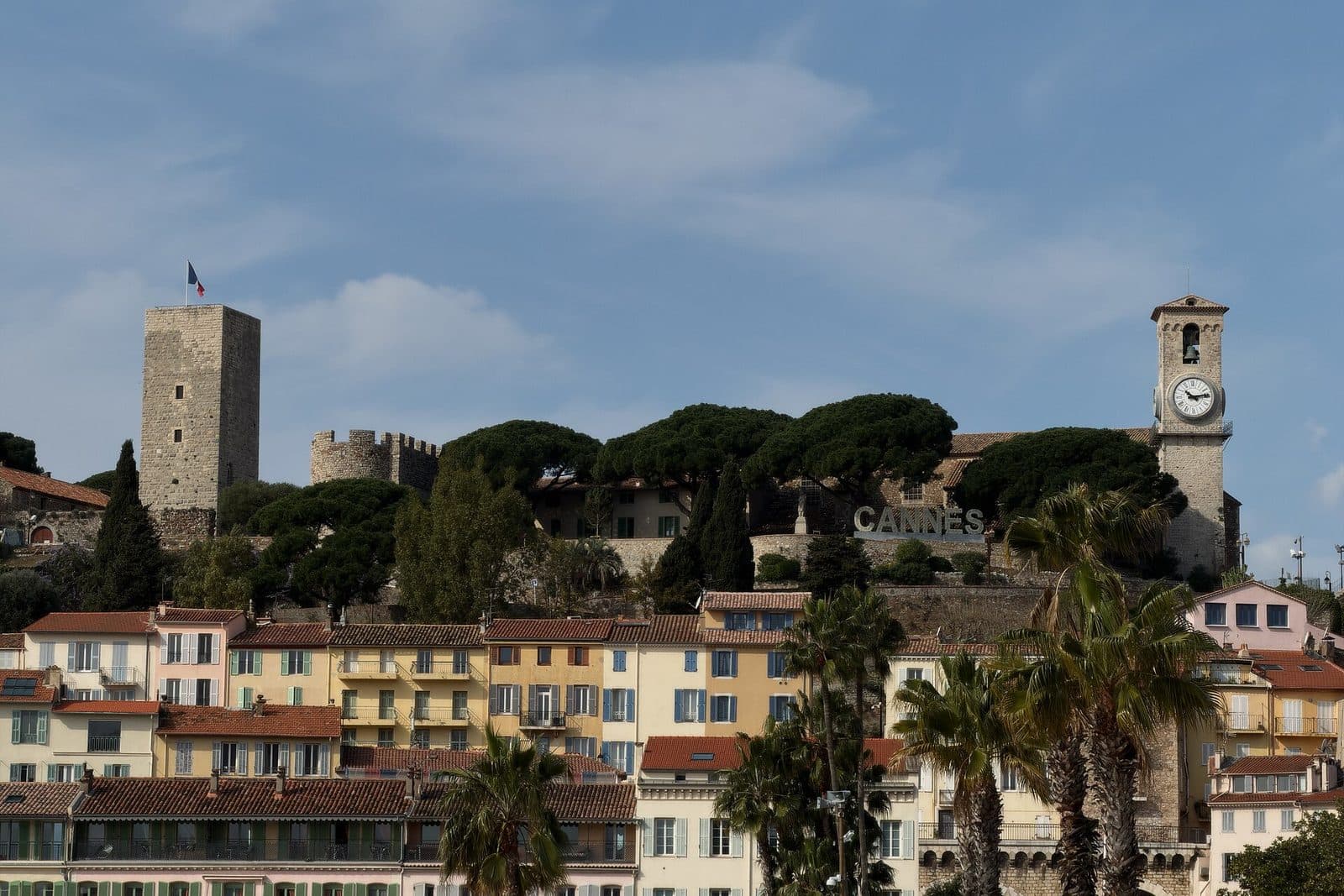
Cannes has been invented three times, and never on purpose. For seven and a half centuries it belonged to monks who governed it from an island; in 1834 a Scottish lord, halted by a cholera cordon, stayed on and made it fashionable; and in 1939 a film festival conceived as an answer to Mussolini's Venice died on the very day it was due to open. This two-kilometre walk climbs from the Palais, which the town calls the Bunker, to the eleventh-century Suquet tower, by way of Napoleon's night in the dunes, the old village's high street, a concrete market dressed up as a Provençal village, the fishermen's boats, and a church paid for partly in barrels of anchovies. At the top, all three Cannes fit into a single view. It ends at the table of a seafood house founded in 1953, over a fish soup and a glass of Provence rosé.
Stops on this tour
- 1
The Palais des Festivals
The municipal casino that stood on this site was demolished in July 1979; the present Palais, the work of the London architect Hubert Bennett and François Druet, an architect from Biot, rises on that site and on land reclaimed from the sea. It opened on 15 December 1982, and the festival climbed these steps for the first time in 1983. Look at the building: grey, horizontal, massive, far more wall than window. Journalists and festival-goers nicknamed it the Bunker the moment it opened. On this very spot, from 1 to 20 September 1939, the first Cannes Film Festival was to have been held, conceived as a reply to Fascist Italy's Venice Mostra. Only one film was ever shown, at a private screening the evening before: Quasimodo, The Hunchback of Notre Dame, by William Dieterle, the first American film in competition. The next day Germany invaded Poland. The festival returned in 1946, with some twenty countries, and in 1949 moved into its first home of its own, the Palais Croisette: it was inaugurated by the mayor, Charles Antoni, while François Mitterrand, then a young government representative, merely gave a speech. The forecourt and the steps are freely accessible. The interior of the Palais can only be visited with event or festival accreditation. From 27 September to 1 October 2026 the Palais hosts a major trade congress (TFWA): expect more signage, barriers and security than usual on the forecourt.
- 2
Notre-Dame-de-Bon-Voyage
The neo-Romanesque church you see was begun in 1868 and consecrated on 2 November 1879; Napoleon saw none of it. In 1815 he found only a humble chapel among the dunes, whose name kept changing (of the Sands, of the Seashore, of the Good Harbour) before it settled on the present one. On the north exterior wall is a plaque, put up on 1 July 1932, commemorating the bivouac of the night of 1 to 2 March 1815, when Napoleon had landed at Golfe-Juan with just over a thousand men and the mayor of Cannes refused him entry to the village, though he did send him provisions. General Cambronne requisitioned the post-house horses on the pretext that he had sick soldiers. The fleur-de-lis that now appears on the town's coat of arms is attributed, by a tradition recorded by the Route Napoléon association, to a reward from the restored monarchy; the municipal archives do not confirm it. The church can be visited outside services; check the times posted at the door. The bivouac plaque is on the north exterior wall.
- 3
Cannolive, the Monks' Shop
The shop opened in 1880 as Aux huiles d'olive de Cabris, founded by a married couple, Paul and Marie Raynaud; in 1955 it was renamed Cannolive, and today the fourth generation of the family runs it. In the window and on the shelves you will find the wines of Lérins Abbey and Lérina, the liqueur in its two colours, green and yellow, that the island's monks have made since 1897. The recipe does not go back to the island's first monks: the community that resettled Lérins in 1869 came from another Cistercian abbey, Sénanque, in inland Provence, and did not invent the liqueur until almost thirty years after arriving. The present name, Cannolive, folds Cannes and olive into a single word; it dates from 1955, seventy-five years younger than the shop itself, which is still in the same family's hands. Opening hours vary; check before you go. If you buy a small bottle, save it for this evening rather than for the table.
- 4
The Statue of Lord Brougham
Henry Brougham, a Scot born in Edinburgh, was the British Baron Brougham and Vaux (a peerage of the United Kingdom, seated at Brougham in Westmorland, England) and served as Lord Chancellor from 1830 to 1834, as well as being an abolitionist in Parliament. In December 1834 he was travelling to Italy with his daughter Eleanor Louisa, who was ill with tuberculosis, when a cholera cordon on the River Var forced them to turn back; he stayed and bought land west of the Suquet. The foundation stone of his villa, designed by the architect Louis Larras, was laid on 10 August 1835; he named it Villa Éléonore-Louise after his daughter, who died on 30 November 1839, aged seventeen. The statue in front of you, by Paul Liénard, was unveiled in 1879 (the pedestal in 1878); it was destroyed in 1941, with no recorded cause, and the sculptor Trivero re-created it identically in 1953. The fountain dates from 1984. Until 1884 these Allées housed the town's covered wooden market. Freely accessible, beside the plane trees of the Allées de la Liberté. The present statue, in white stone, is a 1953 copy, not the original piece. On Sunday mornings there are usually craft stalls and, while the Forville works last, the market tent: the statue stands at the head of the promenade.
- 5
Rue Meynadier
The line of this street dates from the sixteenth century, when it was laid out as the Grand-Rue, the road to Antibes; it was widened around 1880, when the first shops arrived. Its name changed twice in the twentieth century: rue Grande from 1 December 1933, and rue Meynadier, the present name, from 22 March 1945, with the war still on. It honours two men of the same family: Lieutenant Théodore Meynadier, killed on 7 April 1915 at Les Éparges in the First World War, and his son, Captain Roger Meynadier, of the Resistance in Cannes, killed on 13 October 1944. It lies some four hundred metres from the boutiques of the Croisette, but the trade here is different: cheeses, charcuterie, bakeries and oils, in one of the oldest streets in town. A pedestrian street of food shops, at its liveliest in the morning and early afternoon.
- 6
The Marché Forville
The building you see, with its ochre render, wrought-iron balconies, pergolas, Genoese-style tiled cornice and false dovecotes, is reinforced concrete dressed up as a Provençal village. The design competition was won in 1929 by a young architect, Henri Bret, born in Draguignan and trained in Paris, and the market opened in 1932, replacing a first wooden hall of 1884. Since 2023 the market has been undergoing a complete renovation: the 1932 steel was up to 70% corroded in places, and 475 piles up to 20 metres deep have been sunk to meet earthquake standards; the roof, of almost 2,900 square metres, will become an aromatic garden open to the public. The fishermen returned to the hall on 31 March 2026. The town hall calls this market the belly of Cannes. Open Tuesday to Sunday mornings (daily from 15 June to 15 September). The building is still under works: depending on the day you will find scaffolding, part of the hall open, or the stalls under the tent on the Allées de la Liberté. Closed in the afternoon.
- 7
The Vieux Port
The painted wooden boats, pointed at both ends, that you see among the yachts are pointus, a shape that goes back to Antiquity; today some are made of resin and some are electric, but the lines have not changed. Their owners founded the association of the pointus of the Bay of Cannes as a reminder that this town was, before anything else, a fishing village. And before that, it belonged to an island: in 960 the Counts of Provence entrusted the old fortress on this hill to a local lord, Rodoard; around 1030 one of his sons, having entered religion, gave part of these lands to Lérins Abbey, a donation regarded as the birth certificate of Cannes. Around 1080 Abbot Aldebert II fortified the hill and raised the tower that dominates the port. The monastic lordship lasted seven and a half centuries: in 1788 a royal commission closed the monastery for lack of monks, the island was sold off as national property during the Revolution, in 1859 it was bought by the Bishop of Fréjus, and in 1869 Cistercian monks from Sénanque Abbey settled there. The fishermen use this quay in the morning; the boat to the Îles de Lérins leaves from here, a crossing of about 15 to 20 minutes.
- 8
The Climb up Rue Saint-Antoine
Suquet comes from a very old Ligurian root, sukk, meaning height or summit, which passed into Provençal as a diminutive: the little summit. The town likes to say there was a Ligurian settlement here, but according to Wikipedia no archaeological remains have ever been found on this hill; the Iron Age finds of the 1970s, pottery from the fifth century BC, were made on another hill, Saint-Cassien. What is documented is the working Cannes of the twentieth century: a 2024 study records Italian builders, such as Pascal Broggi, listed here in the 1906 census, living in this quarter while they put up the hotels and villas of the elegant town below. It is a single documented case, but it points to something larger: much of the Cannes of the Croisette was built, quite literally, by hands from this hill. A cobbled slope of about ninety metres; comfortable shoes recommended. There is no signposted monument: the street itself is the stop.
- 9
Notre-Dame-d'Espérance
The contract for this church is dated 14 November 1521: the people of Cannes asked for a copy of the church at Roquebrune-sur-Argens, eighteen cannes long by six wide (roughly thirty-six metres by twelve), to be built in three years, for two thousand florins, fifteen écus and fifty barrels of anchovies. The deadline was missed: the church opened for worship in 1632, was finished in 1641, a hundred and twenty years after the contract, and was not consecrated until 13 November 1678, a date recorded by twelve crosses on the pillars. It is late Gothic, with a porch that is already Renaissance; inside, at the oak door, there is a carved skull recalling Golgotha. The organ, on the gallery above the entrance, was built between 1853 and 1856 by the Lingiardi brothers of Pavia and has been rebuilt several times since. In the baptismal chapel are two carvings of St Anne with the Virgin and Child: one fourteenth-century and Burgundian, in solid oak, the other fifteenth-century, in polychrome wood and mutilated. The church replaced an older one, Notre-Dame-du-Puy, within the monks' enclosure, now the Chapelle Sainte-Anne. Generally open 9:00 to 12:00 and 14:00 to 19:00. On Sundays there is a mid-morning mass (around 11:00): if you arrive during it, look in quietly or come back afterwards. Reached by the steps of rue Panisse.
- 10
The Suquet Tower
The tower, some twenty-two metres high, was begun around 1080 by Aldebert II, Abbot of Lérins. Inside, a hundred and nine spiral steps climb to the top; they belong to the Musée des Explorations du Monde, which keeps its own hours and closures (in 2026 it is closed from 14 September to 30 October for works), so do not count on going up. Out to sea: the large island, Sainte-Marguerite, with the Fort Royal, where on 30 April 1687 a prisoner arrived whom history calls the Man in the Iron Mask, arrested near Calais in 1669 under the name Eustache Dauger; his identity is still disputed (a minister fallen from favour, an Italian diplomat, a disgraced general), and he died in the Bastille in 1703. Behind it, out of sight, lies Saint-Honorat, founded around the year 410 by the monk Honoratus. Today the monks cultivate eight hectares of vines (one red is called Saint-Honorat) and, since 1897, have made Lérina there, the liqueur of forty-four plants. It was invented by the community that arrived from Sénanque in 1869; in 1969 the last five monks of Sénanque withdrew to Lérins, bringing their own liqueur, Sénancole. The tower and the Musée des Explorations du Monde are closed for works until 30 October 2026, and there may be fencing around the tower; the free viewpoint at the parapet gives you the view. If it is fenced off, look for the first open gap.
- 11
At Table: Astoux et Brun
Astoux et Brun, at 27 Cours Félix Faure, is a fish and seafood house founded in 1953 and run by the same family for more than three generations; Gault&Millau includes it in its selection and describes it as a seafood brasserie that still brings people together. A lively ground floor, a quieter floor upstairs. On the menu: oysters, seafood platters, mussels, sole in butter and fish soup, made from the rockfish you saw at the market, cooked whole and passed through a sieve, and served with toasted bread, garlic to rub on it, rouille (a mayonnaise of garlic, paprika and saffron) and grated cheese. To go with it, a glass of Provence rosé. No restaurant on the route is confirmed to serve the Lérins wine or liqueur by the glass: the Lérina from Cannolive is for tonight's toast. The boat to the islands leaves from the old port, a few steps away, and takes fifteen to twenty minutes. Open every day, at lunchtime (from 12:00) and in the evening; check that day's hours and ask whether they take reservations. To arrive in time for lunch, start the walk at around 10:30.
Reviews
No reviews yet
Be the first to share your experience