About this tour
Three towns, one argument: that the anti-establishment energy of the 1960s never faded, it got hired. This tour runs from Professorville, the Palo Alto blocks Stanford professors bought from 1889 because the university would only lease them campus land, to the 538-dollar garage on Addison Avenue where Hewlett and Packard started in 1938. Then to Kepler's Books in Menlo Park, opened in 1955 by a jailed conscientious objector and used as a living room by Joan Baez, the Grateful Dead and a teenage Steve Wozniak - the place to sit down and hear about Ken Kesey, Perry Lane and the CIA drug trial that backfired into the counterculture. Then the Stanford basement where a famous prison experiment turned out to be half theatre. It ends over coffee at the business school, with the hobbyists who gave away the schematics for the Apple I. Three hours, with about twenty minutes of driving.
This tour is free thanks to our sponsors.
Subscribe to remove adsStops on this tour
- 1
Professorville — Where Intellect Bought Real Estate
Stand at the corner of Kingsley Avenue and Bryant Street and look down the block: three straight blocks of Dutch Colonial rooflines along Kingsley, broken by Queen Anne towers and low Craftsman porches. This is Professorville, on the National Register of Historic Places since 3 October 1980, bounded by Embarcadero Road, Addison Avenue, Emerson Street and Cowper Street. It exists because of a loophole. Stanford opened in 1891 and would only lease campus land to its faculty, never sell it; in 1889 the land just outside the boundary was subdivided so professors could own outright. They bought here in numbers, and the houses record it. Walk to 450 Kingsley Avenue for the three-storey, fourteen-room Queen Anne with a corner tower built for Fernando Sanford, Stanford's first physics professor. Turn onto Bryant and find number 1061, the Sunbonnet House, designed by Bernard Maybeck. At 1005 Bryant is the Colonial Revival home of Frank Angell, who founded the psychology department. And at 959 Waverley Street lived William Shockley, Nobel laureate, co-inventor of the transistor, and a man who spent his later years promoting racist theories of genetics. The neighbourhood has always held both facts at once.
- 2
The HP Garage — Birthplace of Silicon Valley
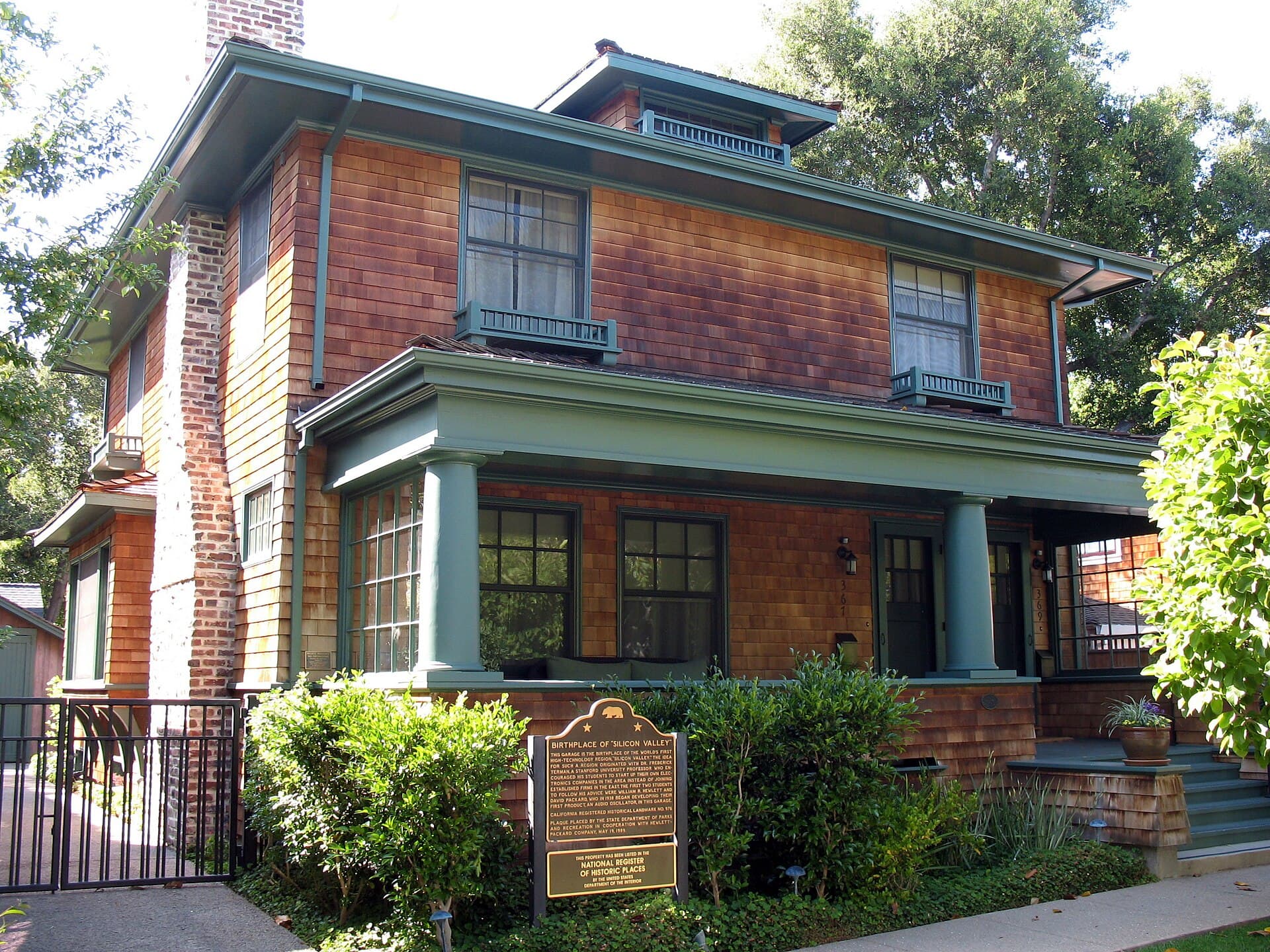
That one-car wooden garage behind the house at 367 Addison Avenue is California Historical Landmark Number 976, and the sign on the fence calls it the Birthplace of Silicon Valley. In 1938 Dave Packard and his wife Lucile rented the first-floor apartment of the house; Bill Hewlett moved into the shed at the back. The two had met in Frederick Terman's radio engineering class at Stanford and both graduated in 1934, and it was Terman who pulled them back to Palo Alto after Hewlett went on to MIT and Packard to General Electric. They started with 538 dollars. Hewlett-Packard was founded on 1 January 1939; a coin toss settled the order of the names, and Packard, who won it, put Hewlett's first anyway. Their first product was the HP 200A audio oscillator, built around a circuit from Hewlett's Stanford thesis. Walt Disney Studios bought eight of them at 71.50 dollars each to tune the sound system for Fantasia. HP bought the property back in 2000 for 1.7 million dollars and restored it in 2005. You can only see it from the pavement, never inside. Note how ordinary the street is: the house in front once belonged to Dr John Spencer, Palo Alto's first mayor.
- 3
Kepler's Books — Roy Kepler's Vision
You are standing in a bookshop that opened on 14 May 1955 and is now past its seventieth year. The man who opened it, Roy Kepler (1920-1994), spent the Second World War being interned repeatedly as a conscientious objector rather than serve, then worked at KPFA in Berkeley, the first listener-supported radio station in America. He wrote his mission down: open minds, deepen literacy, promote critical thinking. Kepler's belonged to what the trade called the paperback revolution, alongside Cody's Books in Berkeley and City Lights in San Francisco - cheap pocket editions rather than leather bindings, sold to whoever walked in. It was among the first shops in the country to rack Playboy and The Paris Review side by side, deliberately, without comment. Look at how the shelving is laid out now and you can still read that intention in it: no gated section, no counter you have to ask across. The store went bankrupt and closed on 31 August 2005, then reopened that October after an unprecedented community mobilisation - new shareholders, volunteers, a hybrid structure. Today it trades as a for-profit bookshop paired with the non-profit Kepler's Literary Foundation. Opening hours have changed over the years, so check before you plan a visit.
- 4
Kepler's Books — The Counterculture's Living Room
Find the cafe corner of the shop, because that is where most of this happened. Roy Kepler's first employee was Ira Sandperl, described by one writer as an oracular presence - the man behind the counter who had read everything and would argue with you for hours. In 1959 Sandperl met a high-school senior at a Quaker meeting: Joan Baez. She became a fixture here, holding informal salons on nonviolence and civil rights, and in 1965 she and Sandperl founded the Institute for the Study of Nonviolence. In 1967 Baez, Sandperl and Roy Kepler were arrested together at an Oakland sit-in during Stop the Draft Week. Jerry Garcia and the Grateful Dead rehearsed in the coffee-house section and played early shows here. Stewart Brand, who would go on to create the Whole Earth Catalog, named Kepler's as one of his formative places. A teenage Steve Wozniak hung around these shelves. Daniel Ellsberg came to ask Sandperl how to survive prison before he leaked the Pentagon Papers. Not everyone approved: right-wing protesters threw a bomb through the window of Kepler's Los Altos store over the anti-war material on sale. Kepler kept the shop open anyway.
- 5
Kepler's Books — Ken Kesey and Perry Lane
Stay in your seat for this one, because the place it describes no longer exists. Perry Lane was a cluster of two-room shingled cottages in an oak wood near where Vine Street meets Sand Hill Road, technically unincorporated San Mateo County with a Menlo Park address. Tom Wolfe wrote it up in The Electric Kool-Aid Acid Test: sixty dollars a month, and getting in was like joining a club. Residents included the psychologist Vic Lovell, the artist Roy Sebern - who painted the word Furthur on the bus - and, reportedly, two Nobel laureates. Jerry Garcia and Phil Lesh played at the parties, which the police sometimes broke up on the grounds that the crowd was racially mixed. In the autumn of 1958 a twenty-three-year-old former wrestler from Oregon moved into cottage number nine with his wife Faye. Ken Kesey had come to Stanford on a Woodrow Wilson National Fellowship, not a Stegner Fellowship: Wallace Stegner rejected his applications more than once, and Stegner's deputy Richard Scowcroft later said neither of them thought Kesey had a particularly important talent. Kesey never finished a degree here. Developers demolished the cottages in August 1963.
- 6
Kepler's Books — MK-Ultra's Accidental Revolution
Somewhere between 1959 and 1961 - the sources disagree on the year - Ken Kesey signed up as a paid volunteer at the Menlo Park Veterans Administration Hospital, minutes from where you are sitting. Seventy-five dollars a session to swallow experimental compounds and report what happened: LSD, which became his favourite, plus psilocybin, mescaline, DMT, cocaine and AMT, alpha-methyltryptamine. Nobody in the room knew who was paying. The money came from the CIA, routed through phoney philanthropic foundations, as part of Project MKUltra - an effort to establish whether psychedelics could be turned into instruments of interrogation, mind control and psychological warfare. It produced the exact opposite of what it was built for. When the formal trials wound up, the researchers left their leftover pills and potions in unlocked drawers and cabinets, and Kesey took them home. Robert Hunter, later the Grateful Dead's lyricist, sat through the same experiments at the same hospital. The neatest irony on this whole walk is that American intelligence, hunting for a weapon, paid for the chemical seed of the counterculture and then lost control of it.
- 7
Kepler's Books — Cuckoo's Nest and the Acid Tests
Kesey was working night shifts as an aide on the wards at the Menlo Park VA while the drug sessions were still running, and in 1960 he began drafting a novel under the eye of Malcolm Cowley, the Viking Press editor teaching at Stanford as a visitor, who - unlike Stegner - was always glad to see him. The result was One Flew Over the Cuckoo's Nest: narrated by a Native American patient feigning deafness, set against Nurse Ratched and the institution she embodies, with Randle McMurphy as the disruptive force. The manuscript won the two-thousand-dollar Harper-Saxton Prize, the book appeared in 1962, and the 1975 film took five Academy Awards. Kesey spent the proceeds on a 1939 International Harvester school bus, painted it in Day-Glo and lettered Furthur across the front, misspelled on purpose. It left La Honda for New York on 17 June 1964 with Neal Cassady at the wheel - Kerouac's Dean Moriarty in the flesh - dispatched, the story goes, from this bookshop. Then came the Acid Tests. On 11 December 1965 the Big Beat, on Highway 101 near Palo Alto, drew about two hundred people, and Jerry Garcia picked up the name Captain Trips.
- 8
Building 420 — The Stanford Prison Experiment
The building in front of you is Building 420 - until 2020 it was Jordan Hall, and Stanford began the renaming because David Starr Jordan, its first president, was a prominent eugenicist. The basement is closed to visitors, but you are standing directly above it. In a thirty-five-foot stretch of that basement in August 1971, the psychologist Philip Zimbardo built a prison. Twenty-four male students were chosen from seventy-five applicants, paid fifteen dollars a day, and randomly assigned as guards or prisoners. Real Palo Alto police officers made the arrests at the students' homes, with the full booking procedure. Three cells, each six feet by nine, held three prisoners apiece on cots behind steel-barred doors; a janitor's closet two feet by two by seven became the hole. Prisoners wore numbered smocks and ankle chains; guards wore khaki uniforms, mirrored sunglasses and carried wooden batons. It was scheduled to run fourteen days. Zimbardo stopped it after six. Even the dates are contested: most sources say 14 to 20 August 1971, while the Stanford archives give 15 to 21.
- 9
Building 420 — What Actually Happened
Same spot, different story. In June 2018 Ben Blum published The Lifespan of a Lie, and the French researcher Thibault Le Texier followed with a book, Histoire d'un mensonge, and a 2019 paper in American Psychologist. Between them the experiment's foundations came apart. The guards had not improvised their cruelty: they were coached, and audio survives of the researcher David Jaffe telling them to be tougher. Douglas Korpi, prisoner 8612, whose screaming breakdown is the study's most-quoted moment, later admitted he faked it - he wanted out so he could revise for his GRE. Dave Eshelman, the guard the prisoners nicknamed John Wayne, had a theatre background and said he had built the character deliberately before he walked in. Le Texier's verdict was that the experiment is closer to cinema than to science. Zimbardo defended it until his death on 14 October 2024. The part worth carrying away concerns the observers rather than the guards: more than fifty people watched this study and exactly one objected - Christina Maslach, freshly finished with her PhD, who confronted Zimbardo in the car park about what he was doing to those boys. He ended it that day, and married her the following year.
- 10
Coupa Cafe — A Cafe That Matters
Coupa Cafe's Stanford Graduate School of Business branch sits in the Knight Management Center at 655 Knight Way. The family behind it is Venezuelan, with children who studied here; the first Coupa opened in downtown Palo Alto in 2004 and the campus branches followed. Order an arepa - that is the thing to get - or a coffee, and take an outdoor table if one is free. The reason this is the last stop is not the coffee. This cafe has become a working room for Silicon Valley: pitches at these tables, investors sitting opposite founders, terms sketched on napkins. It is the present-day end of a line that starts three stops back with a pacifist bookseller. The vocabulary the industry uses about itself - move fast, democratise access, two people in a garage - did not come out of a business school, and a business school is exactly what is standing around you. It came from Kepler's shelves, from the sixty-dollar cottages on Perry Lane, and from a club of hobbyists who gave their circuit diagrams away for nothing. Sit down. The last two chapters put the pieces together.
- 11
Coupa Cafe — The Homebrew Computer Club
Start with the correction: the Homebrew Computer Club never met at Mitchell Park in Palo Alto, however often you read that it did. The first meeting was on 5 March 1975 in Gordon French's garage in Menlo Park, during a rainstorm, with about thirty people. The second was at the Peninsula School, also Menlo Park. From the fifth meeting on, the club settled into the auditorium at SLAC, the Stanford Linear Accelerator Center, on this campus - with swap meets in a Safeway car park and arguments at The Oasis on El Camino Real. French was a contract programmer. His co-founder Fred Moore was a pacifist and conscientious objector out of the Community Computer Center, and Moore wrote the founding flyer that set the terms: schematics, code and prototypes exchanged openly, anti-commercial, democratic. Allen Baum got one of those flyers and brought a friend along on 5 March. Steve Wozniak wrote in iWoz that he began designing what became the Apple I after that first meeting - it was, he said, that inspiring. In March 1976 he demonstrated the Apple I at a Homebrew meeting at SLAC and handed the schematics round; Paul Terrell, a member who ran the Byte Shop in Mountain View, ordered the first fifty.
- 12
Coupa Cafe — From Counterculture to Cyberculture
Here is the argument the whole walk has been building. In the 1960s computers meant IBM: mainframes, rigid organisation, Cold War surveillance. By the 1990s they meant collaboration and a digital utopia that sounded remarkably like a commune. Fred Turner's From Counterculture to Cyberculture (University of Chicago Press, 2006) traces how the first became the second, and puts one man at the hinge: Stewart Brand. Brand read biology at Stanford, took part in legal LSD studies at the International Foundation for Advanced Study in Menlo Park, was present at Kesey's Acid Tests, and produced the Whole Earth Catalog through the Portola Institute in Menlo Park from the autumn of 1968. He called it access to tools: a paper database pointing readers at vendors and ideas. The Last Whole Earth Catalog of June 1971 won the National Book Award in Contemporary Affairs. And the line you know, stay hungry stay foolish, is his - printed beneath a photograph of an early-morning country road on the back cover of the October 1974 Whole Earth Epilog, thirty-one years before Steve Jobs quoted it on this campus in his 2005 commencement address. The chain keeps running: Brand founded The WELL, Fred Moore co-founded Homebrew, John Perry Barlow of the Grateful Dead co-founded the Electronic Frontier Foundation, and Kevin Kelly went from the Whole Earth network to founding editor of Wired.
- 13
Coupa Cafe — Stay Hungry, Stay Foolish
Last chapter, same table. Count what you crossed today: a neighbourhood built on a property loophole, a 538-dollar garage on Addison Avenue, a bookshop that survived a bomb through the window and a bankruptcy, a novelist who got his best material out of a CIA drug trial, a psychology experiment that turned out to be partly stage-managed, and a computer club whose founding question was whether an ordinary person could own a machine. None of these are monuments. A garage you can only see over a fence. A shop. A cafe. The through-line is not the places but a single habit of mind: do not wait for permission, do not ask the gatekeepers, work it out yourself, then give away what you learned. That habit runs from Roy Kepler's paperbacks to Fred Moore's founding flyer to the schematics Wozniak handed round at SLAC, and it is the reason the device in your pocket exists. If you want to keep going, Kepler's is still open on El Camino Real - buy a book there. The HP Garage is visible from the pavement at any hour. And the sign-off belongs to Stewart Brand, October 1974: stay hungry, stay foolish.
Reviews
No reviews yet
Be the first to share your experience