About this tour
Stanford exists because a fifteen-year-old boy died of typhoid in a Florence hotel room in March 1884, and his parents decided that grief would become a university. This walk follows that decision across the campus it built: up the mile of palms Frederick Law Olmsted laid out, into the sandstone quadrangles he and Leland Stanford argued over, to the church Jane Stanford built for her husband and supervised with a parasol for a measuring stick, whose spire the 1906 earthquake brought down fourteen months after she was poisoned in Honolulu in a case still unsolved. Then to Hoover Tower and its Cold War archive, the engineering buildings where Larry Page and Sergey Brin built BackRub, and finally the largest Rodin collection outside Paris, and the golden spike Leland Stanford swung at and missed in 1869. About 2.5 miles, all on paved paths.
This tour is free thanks to our sponsors.
Subscribe to remove adsStops on this tour
- 1
Palm Drive — The Miracle Child
You are at the town end of Palm Drive, where University Avenue crosses El Camino Real and becomes a straight, mile-long avenue of palms aimed at the Main Quad. Frederick Law Olmsted, the designer of New York's Central Park, laid out this approach. The flat ground on either side was the Palo Alto Stock Farm, Leland Stanford's horse-breeding operation, and it is why students still call the campus The Farm. Leland DeWitt Stanford Junior was born in Sacramento on 14 May 1868, after his parents had been married eighteen years without a child. Leland Senior was forty-four, Jane thirty-nine. The boy spoke French and German, sketched trains and ships, collected archaeological artefacts and, at fifteen, was already planning a public museum for San Francisco. His tutor Herbert Nash wrote that he could not see macaroni made without demanding an explanation of the whole process, or glass blown without learning every detail of the business. He rode his pony across this land with dogs at his heels, and once splinted a stray dog's broken leg himself over the servants' objections. Look down the palms: the sandstone arcades at the far end are a mile away, and every one of them exists because of this child.
- 2
Palm Drive — Death in Florence
Keep walking. The palms were planted to make this a processional approach, so the buildings reveal themselves slowly. In June 1883 the Stanfords left California for a grand tour of Europe with their son: London, Paris, Rome. By January 1884 they had reached Athens, where fifteen-year-old Leland trudged through knee-deep snow to see the ancient temples and arranged to meet Heinrich Schliemann, the archaeologist who had dug at Troy. Somewhere on the road, probably in contaminated food or water, he picked up typhoid fever. The family rushed him to Florence and took rooms at the Bristol Hotel. Doctors wrapped him in ice-cold wet sheets to break the fever. Nuns nursed him in shifts around the clock. The hotel manager had straw spread on the street outside so passing carriages would not disturb him. On 25 February Jane wrote in her diary that she had turned for comfort to the Giver of both good and evil, and now turned to Him again with entreaties to save her darling son. He died on 13 March 1884, two months short of his sixteenth birthday. Everything ahead of you along this avenue was built in the eleven years that followed.
- 3
The Oval — The Children of California
Ahead is the Oval, then the sandstone archway into the Main Quad. Standing here you are looking at the answer the Stanfords gave to their son's death. They weighed three ideas: a museum in San Francisco, which would have honoured Leland Junior's own dream, a technical school, or a university. They toured Harvard, Yale, Cornell and MIT, and asked Harvard's president Charles Eliot what endowment a university would need. Not less than five million dollars, he said. After a silence, Leland turned to Jane: well, Jane, we could manage that, couldn't we. She nodded. The story that Eliot dismissed them as country bumpkins is a myth, debunked by the Harvard Crimson. Stanford opened on 1 October 1891 with about 555 students, forty more than Berkeley enrolled that year. From the first day it was co-educational, non-denominational and free of tuition, and it stayed tuition-free until 1920. The first student to register got the honour by being the first to sleep in Encina Hall: a seventeen-year-old orphan from Iowa named Herbert Hoover, later the 31st President of the United States. His tower is the tall one away to your left as you face the Quad.
- 4
Inner Quad — Olmsted versus Stanford
You are in the Inner Quad, the oldest ground on campus, with Memorial Church straight ahead and continuous arcades running round all four sides. This layout is a compromise between two stubborn men. Leland Stanford hired Frederick Law Olmsted, by then the most celebrated landscape architect in America, designer of Central Park, Brooklyn's Prospect Park and the grounds of the United States Capitol. Olmsted wanted the university up in the foothills: winding roads, buildings tucked into the folds of the land, picturesque. Stanford refused. He wanted it here, on the flat of his own stock farm, visible from the road and easy to extend. Olmsted gave way and did something better than sulk. He designed interlocking quadrangles set on north-south and east-west axes, so the campus could grow by adding courts rather than sprawling. He also argued for native, drought-tolerant planting instead of imported ornamentals, which reads as prophecy in a state that now rations water. Stanford paid him a consulting fee of 10,000 dollars, roughly 330,000 today, without a word of complaint. The axis you are standing on runs slightly east of north, aimed at the old railway station.
- 5
Inner Quad — Sandstone and Round Arches
Put your hand on the wall. The sandstone is deliberately rough-hewn, quarried locally and left with the chisel marks showing, because these buildings were meant to look as though they had always been here. The arches are round and low, the columns squat, the capitals carved individually, and over the top of all of it sit red mission tiles, a Californian graft onto a Massachusetts idea. The style is Richardsonian Romanesque, named for Henry Hobson Richardson, who died in April 1886, the same year planning began here. The commission went to his successor firm, Shepley, Rutan and Coolidge of Boston, with Charles Allerton Coolidge as lead designer. The same practice went on to design the Art Institute of Chicago, the University of Chicago campus, Harvard Medical School and twenty-three stations for the Boston and Albany Railroad. It is still working today under the name Shepley Bulfinch. Walk a few metres along the arcade and look at the capitals in sequence: the carving changes as you go. The church at the end of the Quad was not Leland's project at all. It was Jane's, and she supervised it with a rigour that alarmed her contractors.
- 6
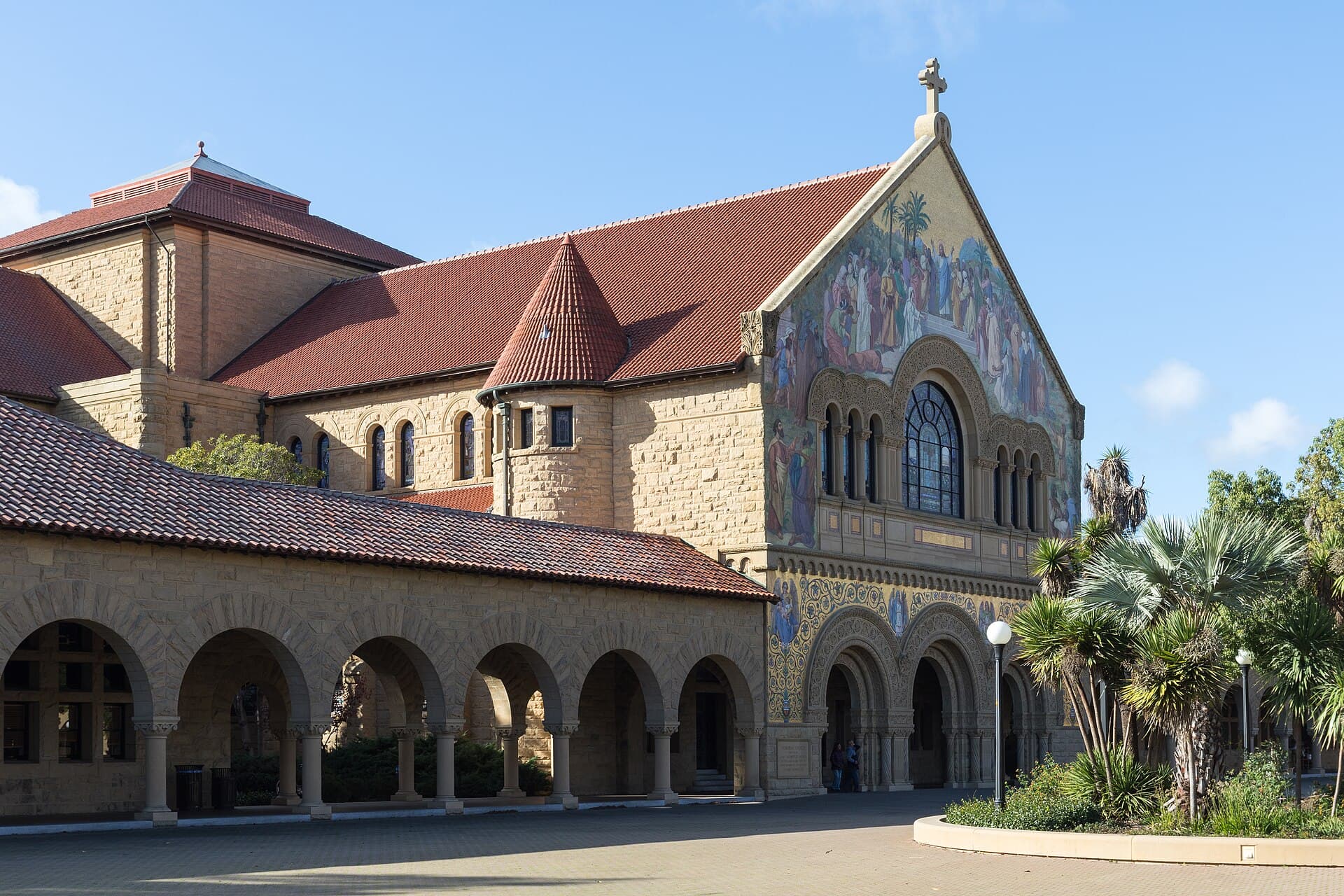
Memorial Church — Jane's Masterpiece
The mosaic filling the front of Memorial Church is the Sermon on the Mount: eighty feet wide, thirty feet tall, forty-seven figures, every tessera set by hand. When it was made it was among the largest mosaics in the United States. Leland Stanford died on 21 June 1893, two years after the university opened, and Jane built this church as his memorial. It was dedicated on 25 January 1903. She said of it: while my whole heart is in the university, my soul is in that church. She was not a distant donor writing cheques. She spent two months in Venice working with Maurizio Camerino of the Antonio Salviati studios, choosing the designs herself. The chief artist, Professor Antonio Paoletti, was sixty-six and among the finest mosaicists in Italy, and painted the original watercolours. On site she carried a parasol and used it as a measuring stick, holding it against the carvings to check that their depth matched the European cathedrals she had studied. If a carving fell short, she said so. Stand back far enough to take in the whole front, then look along the roofline above it. Something that was there in 1903 is missing now.
- 7
Memorial Church — The Interior and the Earthquake
Inside, nothing on the walls is painted. Every image is mosaic, built from thousands of small glass and stone tesserae: prophets, apostles, angels, scenes from both Testaments, and behind the altar a mosaic version of Cosimo Rosselli's Last Supper. The windows are the other half of the commission, designed by Frederick Stymetz Lamb and made by J and R Lamb Studios of New York. Twenty large windows, three years to create, eight months to install, the largest American stained-glass commission of its time. The church has always been non-denominational, which was Leland's condition, and more than seven thousand weddings have been held in it. Now the missing piece. The original church had an eighty-foot, twelve-sided spire. At 5:12 in the morning on 18 April 1906 the San Francisco earthquake brought it straight down through the chancel roof, and the whole mosaic front collapsed forward into the Quad. Twelve apostle statues near the altar were destroyed and never replaced. Reconstruction was finished in 1913, but the spire was never rebuilt. A domed skylight took its place, which is why the roofline outside looks oddly flat.
- 8
Memorial Church — The Murder of Jane Stanford
Sit down for this one. Jane Stanford, who built the church behind you, was murdered. On 14 January 1905, at her San Francisco mansion, she drank Poland Spring mineral water that tasted bitter and immediately made herself vomit, which saved her life. Analysis found strychnine, in the form of impure nux vomica. Frightened, she left California for Hawaii with her secretary, Bertha Berner. On the night of 28 February, at the Moana Hotel in Honolulu, she took bicarbonate of soda for indigestion and within moments was convulsing. She called out that she had no control of her body and thought she had been poisoned again. Her last words were: my jaws are stiff, this is a horrible death to die. Tetanic spasm is the signature of strychnine. Stanford's first president, David Starr Jordan, travelled to Honolulu and told the press she had died of heart disease. The cover-up held for most of a century. In 2003 Stanford University Press published Dr Robert Cutler's account, which established the poisoning beyond argument, and in 2022 the historian Richard White went after the motive. The obvious suspect was Berner, present at both attempts. There was never an arrest. The case is still open.
- 9
Hoover Tower — Herbert Hoover's Stanford
Two hundred and eighty-five feet, the tallest thing on campus, named for a boy who nearly did not get in. Herbert Hoover arrived in 1891 aged seventeen, an orphan from Iowa, having failed every entrance examination except mathematics. Stanford admitted him on condition that he take remedial work. He claimed the title of the university's first registered student by being the first to sleep in Encina Hall. He read geology under Professor John Casper Branner, ran a laundry service for other students to pay his way, and met Lou Henry here, who in 1898 became the first woman to take a Stanford geology degree. He graduated in 1895, made a fortune in mining, and by his forties was one of the richest men in America. Then the First World War. Hoover organised the relief that fed millions of Belgians under German occupation, and did the same for Russian famine victims afterwards. In 1919 he gave Stanford fifty thousand dollars to found what he called a library of war, revolution and peace, to document how the war had happened. That gift became the Hoover Institution, and this tower was built to hold it.
- 10
Hoover Tower — The Belgian Bells
Look up at the top stage, where the openings are. There are forty-eight bells up there, a carillon, and they were never meant for California. They were cast in 1938 by the Michiels bellfoundry in Tournai, Belgium, for the Belgian Pavilion at the 1939 New York World's Fair. When the fair closed, the Belgian-American Educational Foundation gave them to Stanford as thanks for Herbert Hoover's wartime relief, which had kept millions of Belgians alive. The largest weighs two and a half tons and carries the inscription Uno Pro Pace Sono: for peace alone do I ring. They were first played on 18 March 1941. In 2021 the instrument was renamed the Lou Henry Hoover Carillon after Hoover's wife. The tower itself is Art Deco, designed by Arthur Brown Junior, architect of San Francisco City Hall and Coit Tower, and modelled on the bell tower of Salamanca Cathedral in Spain. It was dedicated on 20 June 1941, the university's fiftieth anniversary. Inside, floors one to nine are book stacks, ten to twelve offices, thirteen the carillon mechanism, and fourteen the observation deck. Check current hours at the visitor centre if you want to go up.
- 11
Hoover Archives — Cold War Secrets in the Stacks
The doors beside you open onto one of the great political archives of the twentieth century: over a million volumes in a hundred and fifty languages on thirty miles of shelving. In 1926 Hoover's researchers quietly shipped out the files of the Okhrana, the Russian Tsarist secret police, from its Paris bureau. The papers sat in this tower unacknowledged until 1957. During the Cold War the Institution became one of the West's principal holdings of Soviet material, and it has more than eleven million pages of Soviet Communist Party archives, microfilmed between 1992 and 1996 in the short window when Moscow's archives were open. It holds the papers of dissidents including Solzhenitsyn, Sakharov and Pasternak, the complete broadcast records of Radio Free Europe and Radio Liberty, forty-seven manuscript boxes of Ronald Reagan material, and the Ba'ath Party archives taken from Iraq after 2003. Aleksandr Solzhenitsyn, who wrote The Gulag Archipelago, lived on the eleventh floor of this tower during the 1970s before moving to Vermont. Most people photograph the outside and walk on.
- 12
Packard Building — Hewlett, Packard and Terman
The building in front of you carries one half of the most famous partnership in this valley. Bill Hewlett and Dave Packard met at Stanford in the early 1930s in a radio engineering class taught by Professor Frederick Terman, and both graduated in 1934 with electrical engineering degrees. Hewlett went east to MIT, Packard to General Electric, and Terman pulled them both back with fellowships. On 1 January 1939 they started a company in a one-car garage at 367 Addison Avenue, in Palo Alto's Professorville, with five hundred and thirty-eight dollars of capital. Legend says Terman lent them part of it. A coin toss decided the name. Packard won and put Hewlett's first anyway. Their first product was the HP 200A audio oscillator, built from a circuit in Hewlett's Stanford thesis, and their first big customer was Walt Disney Studios, which bought eight at 71 dollars 50 each to test the sound system for Fantasia. That garage is California Historical Landmark 976, officially the Birthplace of Silicon Valley. It is about a mile from here, visible from the pavement but closed to visitors. Terman later became Stanford's provost and made a policy of pushing graduates to found companies nearby. That policy is the reason for everything around you.
- 13
Gates Building — Where Google Was Born
This is the William Gates Computer Science Building, 353 Jane Stanford Way, finished in January 1996 at a cost of thirty-eight million dollars. In the spring of 1995 a second-year PhD student called Sergey Brin volunteered to show a prospective student around campus. The visitor was Larry Page. By most accounts they argued about nearly everything, and Brin's word for Page was obnoxious. They also talked for hours. Page took the link structure of the World Wide Web as his dissertation subject, and together they built a search engine that ranked pages by who linked to them. They called it BackRub, and put it on Stanford's website in August 1996. The work moved into this building, where Brin was known for rollerblading down the corridors. They registered google.com in September 1997. The following summer Andy Bechtolsheim, a co-founder of Sun Microsystems, watched a demonstration and wrote a cheque for a hundred thousand dollars to Google Inc, a company that did not yet legally exist. They had to incorporate in order to bank it. Google was founded on 4 September 1998. Sun itself is named for the Stanford University Network, Cisco grew out of a campus networking project, and Yahoo started in a campus trailer until the university asked its founders to leave for using too much bandwidth.
- 14
Cantor Arts Center — The Magnificent Obsession
The low modern building is the Cantor Arts Center, 328 Lomita Drive, and the lawn of bronzes beside it is the reason people come. In 1973 an American investment banker named B. Gerald Cantor visited Stanford for the first time and said he had an immediate affinity with the place. Cantor had what he called a magnificent obsession: the sculpture of Auguste Rodin. He befriended Cecile Goldscheider, director of the Musee Rodin in Paris, and over decades assembled the largest private Rodin collection ever made, some seven hundred and fifty pieces. In February 1974 he gave Stanford eighty-nine Rodin sculptures, the largest gift of sculpture ever made to a university art museum. Through the 1980s and 1990s he added more than two hundred and fifty further Rodin-related objects. Stanford's Rodin holdings now number one hundred and ninety-nine works, the largest anywhere outside Paris and the Soumaya museum in Mexico City. The garden is open twenty-four hours a day, every day of the year, which is unusual for a collection of this value.
- 15
Rodin Garden — The Gates of Hell
This is the B. Gerald Cantor Rodin Sculpture Garden, dedicated in 1985 and designed by Robert Mittelstadt to echo the Bagatelle gardens in Paris: one acre, twenty monumental bronzes. The tall doors at the eastern end are The Gates of Hell. Rodin began them in 1880 and was still working on them when he died in 1917. They were never finished, and they carry more than a hundred and eighty individual figures. Look at the top: the three identical stooping figures are The Three Shades, one figure cast three times and turned. Then look below them and find the small seated man leaning on his hand. That is the original Thinker, made as part of this door before Rodin enlarged him into the sculpture everyone knows. The enlarged version is indoors in the museum. Around the lawn are Adam and Eve, both originally intended to flank the Gates, and The Walking Man, a torso with no head and no arms, Rodin's study of pure motion. Two heads from the Burghers of Calais are here as well. The full-size Burghers stand in Memorial Court in front of the Main Quad, which you walked through earlier.
- 16
Cantor Arts Center — The Golden Spike
Go into the museum and find the Stanford Family gallery. In a case there is a small gold spike, and it is the real one. On 10 May 1869 at Promontory Summit in Utah, the Central Pacific building east from California met the Union Pacific building west from Omaha, and the first transcontinental railroad was complete. Leland Stanford, president of the Central Pacific, was handed a ceremonial spike of 17.6-carat gold alloyed with copper, weighing just over fourteen troy ounces. He swung the hammer and missed, hitting the rail instead. Thomas Durant of the Union Pacific missed as well. An ordinary railroad worker drove the spike home. It is engraved: May God continue the unity of our Country, as this Railroad unites the two great Oceans of the world. Stanford's brother-in-law David Hewes, who had commissioned it, gave it to the Stanford Museum in 1898. The Nevada silver spike, twenty-five troy ounces, is displayed alongside it. The man who swung and missed at Promontory is the same man who, fifteen years later, sat by a bed in Florence and then decided to build a university.
- 17
Rodin Garden — Grief Into Purpose
You have finished. Behind you: a boy who wanted to know how macaroni was made, a mother who measured stone carvings with a parasol, a church whose spire came down at 5:12 on an April morning in 1906, a poisoning in Honolulu that nobody was ever charged with, a tower holding the Okhrana files and eleven million pages of Soviet Party archive, and a garden of Parisian bronzes standing under palm trees they were never made for. If you want to keep going, the campus has more. The Dish trail in the hills behind campus gives you the whole Bay. The Stanford Mausoleum, a few minutes west of here between the museum and Palm Drive, holds Leland, Jane and their son together in one tomb, with sphinxes at the door. The Papua New Guinea Sculpture Garden is a short walk south. The Anderson Collection, next door to the Cantor, holds one of the finest private gatherings of postwar American painting anywhere, and like the Cantor it is free. All of it exists because two people decided, in the worst month of their lives, that the children of California would be their children.
Reviews
No reviews yet
Be the first to share your experience