About this tour
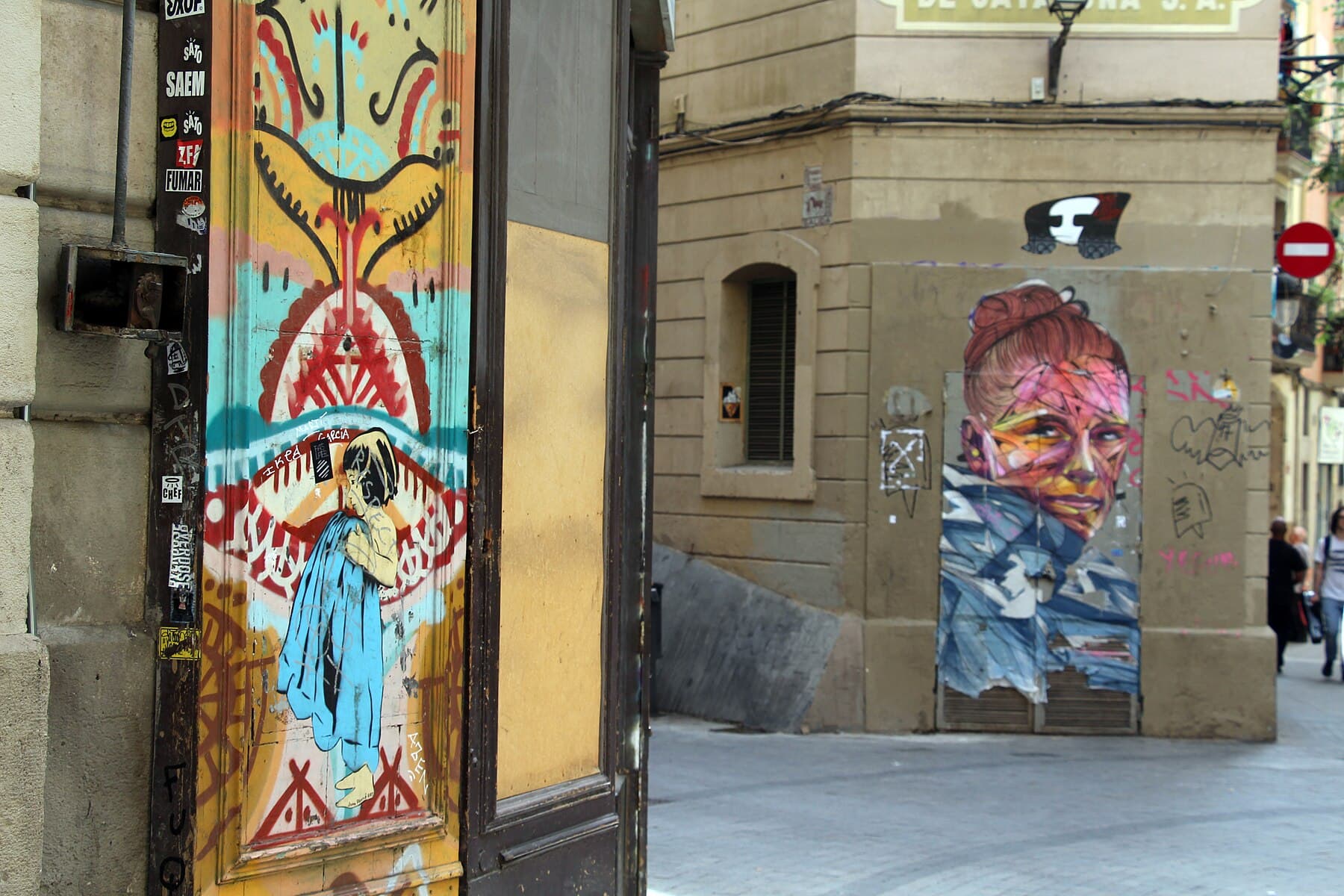
Four hours from El Raval to Poblenou with Marta, a Barcelona art-history graduate, on why a city forbidden to speak Catalan in public for forty years learned to say things in paint instead. Keith Haring's anti-AIDS mural of February 1989 and the 2014 reproduction that stands in for it beside MACBA. El Xupet Negre's black dummy, the tag that invented logo-art in the Raval in 1987, and Botero's bronze cat on a street that was cut through five demolished blocks in 2000. Lunch at Bar Joan inside Miralles' wave-roofed Mercat de Santa Caterina, which is the honest local alternative to La Boqueria. The Murs Lliures legal walls in Poblenou, where a booked slot lasts about a week. And a closing stop on the old village rambla, where the last words of an anarchist executed in 1974 still go up on shutters across the city.
This tour is free thanks to our sponsors.
Subscribe to remove adsStops on this tour
- 1
Plaça dels Àngels & the Keith Haring Wall
The wall in front of you, on the Carrer de Ferlandina side of Plaça de Joan Coromines beside MACBA, is a reproduction, and it matters that you know which one you are looking at. Keith Haring painted the original on 27 February 1989, arriving at noon and finishing in about five hours, on a wall in Plaça Salvador Seguí a few hundred metres south — then the centre of El Raval's heroin and HIV crisis. He was thirty and dying of AIDS; he died on 16 February 1990, eleven months later. The words are Todos juntos podemos parar el sida. That original wall was demolished in the 1990s during the Raval regeneration, the same clearance that opened the ground this square sits on. In February 2014, twenty-five years after the fact, MACBA, the Keith Haring Foundation and the city council had the mural reproduced here. There is nothing left to see at Plaça Salvador Seguí; this copy is the only version standing. That square, incidentally, is named for Salvador Seguí, El Noi del Sucre, the CNT anarcho-syndicalist shot dead in 1923 by gunmen hired by employers — so Haring's mural stood, and its ghost still stands, on Barcelona's anarchist memory. MACBA itself, the white Richard Meier building, opened in 1995. Look down: these smooth concrete ledges made this one of the most famous skate spots on earth from the late 1990s, and the expansion approved in 2023 puts that plaza in play.
- 2
Rambla del Raval & El Xupet Negre
Start at the cat. Seven metres of bronze, unapologetically fat, by the Colombian sculptor Fernando Botero: the city bought it in 1987, shuffled it around for years, and set it down here in 2003. Locals call it El Gat del Raval, and it is the only thing on this street older than the street. Rambla del Raval did not exist until 2000, when five blocks of tenement housing were demolished under the Pla Central del Raval and around a thousand people — Pakistani, Filipino and Moroccan families, elderly Catalan widows — were moved out so the city could cut a palm-lined avenue through for light and air. The cat saw the old grid. Almost nobody else who lived on it did. This is also where Barcelona street art begins. In 1987 a nineteen-year-old art student started marking Raval with a felt pen, and in 1989, the year Haring came, switched to spray. He signed with a cartoon black dummy instead of letters: El Xupet Negre, born 1969, generally credited with inventing logo-art, and on most lists of the fifty most influential street artists working. His pioneering contemporaries were Inupié, Sutíl and Sendy's. The dummy turns up on shutters, poles and doorframes across the Raval, but no single piece is guaranteed to be there — they get buffed and repainted constantly. Come back after closing: the persianes, the roller shutters, are the real gallery here and they are invisible by day. Since the 2006 Ordenança de Civisme, unauthorised painting carries fines of up to 3,000 euros.
- 3
Mercat de Santa Caterina — Bar Joan
Look up before you go in. The roof is Enric Miralles and Benedetta Tagliabue's: 325,000 hexagonal ceramic tiles in 67 colours, laid so that from above the building reads as a market stall piled with fruit and vegetables. Miralles died in 2000; Tagliabue carried it through to completion in 2005. Underneath it is the oldest covered market in Barcelona, opened in 1848 on the site of the Dominican convent of Santa Caterina, which the workers of the city burned down in July 1835 during the bullangues, the anti-clerical riots, at a moment when the church was holding grain and the city was hungry. A market built on the ashes of an uprising is a very Barcelona sequence of events. Now the food, and be specific about it, because this is the honest alternative to the market everyone else goes to. Head to the back of the hall and find Bar Joan, a counter with about ten stools at Avinguda de Francesc Cambó 16, run by the same family since the 1950s, where the butchers and fishmongers eat when they clock off. Order the capipota, slow-cooked pork head with chickpeas, a working-class Catalan dish; or the arròs del dia; or the menú del dia, around 16 euros in recent years for starter, main, dessert and a drink. Cash is easier. The market trades Monday to Saturday and shuts on Sunday, and the good lunch goes early. Skip La Boqueria, fifteen minutes west on La Rambla: it stopped being a market for locals around 2012.
- 4
Poblenou Free Walls (Murs Lliures)
The block bounded by Pallars, Agricultura, Veneçuela and Josep Pla, two minutes from Selva de Mar on metro L4. This is a Murs Lliures wall — free walls — a programme launched in 2012 by the Rebobinart association with the city council, six years after the 2006 civic ordinance turned unauthorised painting into a 3,000-euro offence. Artists book a slot at wallspot.org, turn up on their day, paint in daylight, and get painted over by the next booking within days or weeks. The scheme takes over 5,000 bookings a year city-wide; this wall alone has taken more than 2,500, second only to Tres Xemeneies in Poble-sec. So whatever is on it today is probably less than a month old, and there is no named piece to hunt for — that is the design, not a failure. Watch what permission does to the painting. Legal time buys ladders, masking, blends, finished lettering, a signature and often an Instagram handle; it also tends to buy content that a council photograph can live with. The riskier statement is usually the small illegal piece around the corner, done fast in the dark. Then read the neighbourhood behind you. This was Manchester Català, the industrial core of nineteenth-century Catalonia, and its factories held the strongest CNT base in Europe; the 1919 La Canadenca strike spread through these blocks and ended with Spain legislating the eight-hour working day. The 22@ plan of 2000 rezoned the same land for tech offices, and rents roughly doubled between 2014 and 2024.
- 5
Rambla del Poblenou — How a City Remembers
Rambla del Poblenou at Carrer de Pujades: notice the width, the low buildings, the quiet. This was an independent municipality until Barcelona annexed it in 1897, and people here still say anar a Barcelona, going into Barcelona, when they mean going anywhere else. Two hundred metres up, Plaça de Prim keeps four huge ombú trees planted in the 1800s, among the oldest surviving in the city and the emblem of Ens Plantem, the neighbourhood movement whose name puns on planting and standing firm. This rambla held popular assemblies in 2011 during the 15-M indignados movement, months before Occupy, in the same horizontal format the CNT ran here in the 1930s. A few blocks inland the Can Ricart textile complex was saved from demolition between 2005 and 2007 by an occupation of artists, squatters and neighbourhood grandmothers — the first real defeat handed to 22@. The murals here change constantly; the signatures worth knowing are Roc Blackblock, BToy and Axe Colours, and the Difusor collective runs Poblenou's street-art festival. In 2024, for the fiftieth anniversary, Roc Blackblock painted Salvador Puig Antich, the young Catalan anarchist garrotted by the Franco regime in March 1974 at twenty-five — but that mural is up in Vallcarca, on the other side of the city, not here. His last words to his sisters, Digueu-los que segueixin lluitant, keep reappearing on shutters and stencils all over Barcelona. Forty years of a banned language is why this city says things in paint.
Reviews
No reviews yet
Be the first to share your experience