About this tour
Walk the actual buildings, basements, and pieces of pavement where Berlin techno was invented. Your guide Lukas was nineteen the night the Wall came down. Over four hours and a couple of U-Bahn hops you'll stand at the original Tresor vault on Leipziger Straße, on the Ku'damm where the first Love Parade rolled in July 1989, outside E-Werk where Paul van Dyk made his name, in front of the Kreuzberg basement that housed the UFO club, on a Späti curb (with a beer, as required), and finally across the street from Berghain — not going in, just registering what the building means. Real names, real years, real events, zero pretension.
This tour is free thanks to our sponsors.
Subscribe to remove adsStops on this tour
- 1
Original Tresor — Leipziger Straße 126
Leipziger Straße 126 to 128 no longer looks like anything: the block was cleared after 2005 and rebuilt, and the shopping centre and offices around Leipziger Platz now sit on it. What you are standing on was the death strip. The Wall ran through here, and this was sand, floodlights and dog runs until November 1989. Underneath the rubble of the Wertheim department store, one of the largest shops in Europe before the war, a steel bank vault installed in 1926 had sat sealed for six decades. Dimitri Hegemann, who had just lost his acid-house club UFO, climbed down into it with a torch in early 1991 and opened Tresor — German for safe — at midnight on 13 March 1991. Twenty metres of concrete over your head, no ventilation, wet walls, rows of safety deposit boxes still in the brickwork, and Detroit techno on the system: Jeff Mills, Blake Baxter, Juan Atkins flying in from Michigan to plug drum machines into a room that had not been opened since the Kaiser. The club was forced out in 2005 and reopened in 2007 in the Kraftwerk power station on Köpenicker Straße, where it still runs. The one physical piece left of the original is the 1926 vault door itself: it is on show in the Berlin Global exhibition at the Humboldt Forum, about ten minutes east of here.
- 2
Wittenbergplatz — First Love Parade 1989
The building filling the square is KaDeWe, the Kaufhaus des Westens, trading since 1907 and still West Berlin's cathedral of retail. Behind you is the 1913 U-Bahn station hall — go down and look at the wooden ticket booths and enamel signage, one of the last near-intact pre-war station interiors in the city. Now be honest about the geography while you stand here: the first Love Parade did not start on this square. It rolled down the Kurfürstendamm, and Wittenbergplatz is the eastern end of that shopping axis — Tauentzienstraße runs west from here to the Gedächtniskirche, where the Ku'damm proper begins about a kilometre away. What happened on 1 July 1989 was one Volkswagen Beetle with speakers strapped to the roof and a cassette deck wired into a car battery, followed by roughly 150 people in spandex, pyjamas and body paint. At the front was Dr. Motte — Matthias Roeingh — alongside the American artist Danielle de Picciotto, whose idea it had been. A street party was illegal and a political demonstration was not, so they registered it with the police as a demo, under the motto Friede, Freude, Eierkuchen: peace, joy, pancakes. Four months later the Wall came down. By 1995 the parade drew 500,000 people; by 1999, around 1.5 million.
- 3
E-Werk — Wilhelmstraße 43
Red brick, tall arched windows, heavy industrial doors: this is the Abspannwerk Buchhändlerhof, an electrical substation built in 1928 to push power into the government quarter. E for Elektrizität. Look at the brickwork and the ventilation louvres — nothing about the outside was softened to make it a club. It ran as E-Werk for only four years, 1993 to 1997, and a startling amount of what mid-nineties dance music became happened inside it. The Friday residency was called Dubmission, held down by Kid Paul and by a DJ then in his early twenties named Paul van Dyk; he later titled a remix of For An Angel the PvD E-Werk Club Mix as a tribute to this room, and it became one of the biggest trance records ever made. Derrick May, Juan Atkins and Kevin Saunderson — the three men who invented techno in Detroit — kept flying over, as did Carl Cox, Sven Väth and DJ Hell. Register where your feet are: the original Tresor vault was a couple of hundred metres from this door, and in 1994 you could leave one at four in the morning and be inside the other ten minutes later, through streets nobody was policing and buildings nobody was charging rent for. The building survives; it is used now for fashion shows and corporate events, and has hosted parties again in recent years.
- 4
Späti at Rosenthaler Platz
Pick a Späti — any Späti; there are several within sight of the tram tracks at Rosenthaler Platz — and look for the three tells: a fridge wall of beer, a crate of empties stacked by the door, and a bottle opener tied to a string or screwed to the counter. The word is short for Spätkauf, late purchase, and it only entered the Duden dictionary in 2017. The institution is much older: East Germany opened Spätverkaufsstellen in the 1950s so factory workers coming off the night shift could still buy bread and milk, and after 1989 the idea spread across the whole city. There are roughly a thousand now, most of them run by Turkish, Arab and Vietnamese families, and they survive in the gaps of Germany's strict shop-closing laws — open at midnight, at four in the morning, on Sundays, on Christmas Day. Order correctly: a Sterni, which is Sternburg Export, usually somewhere around a euro fifty. Ask them to open it. Then hand the empty bottle back over the counter instead of binning it, because the deposit is eight cents and the person who would otherwise collect it is not doing that for fun. Then sit on the kerb. That is the whole exercise: in Berlin a night out does not start in a bar, it starts on a Späti kerb, and the plan for where to go forms there.
- 5
UFO Club Site — Köpenicker Straße 6
There is no plaque, no sign and nothing to photograph — a stretch of Köpenicker Straße with flats above and a door at street level — and that is exactly right for a club that was never meant to be found. In 1988 Dimitri Hegemann, Achim Kohlenberger and a former history student named Carola Stoiber rented a basement on this street and called it Fischbüro. The ceiling was 1.90 metres: hold a flat hand above your head and you have it. You got down to the dancefloor on a wooden ladder. The kitchen was outside the building. There was no licence, no fire exit and barely any light. They renamed it UFO and started importing acid house, the squelching Roland TB-303 music coming out of Chicago that almost nobody in Germany had heard yet, which makes this Berlin's first acid-house club. The residents were Tanith, Jonzon, Rok, Dr. Motte — who would launch the Love Parade the following July — and a thirteen-year-old called Kid Paul, whose mother had to bring him. When the authorities caught up in 1989 the crew moved the operation to Großgörschenstraße in Schöneberg and ran it until 1990. The next year the same people opened Tresor. Look along the street while you are here: Tresor's current home, the Kraftwerk power station at Köpenicker Straße 70, is a short walk away. The whole line runs down one road.
- 6
Outside Berghain — Am Wriezener Bahnhof
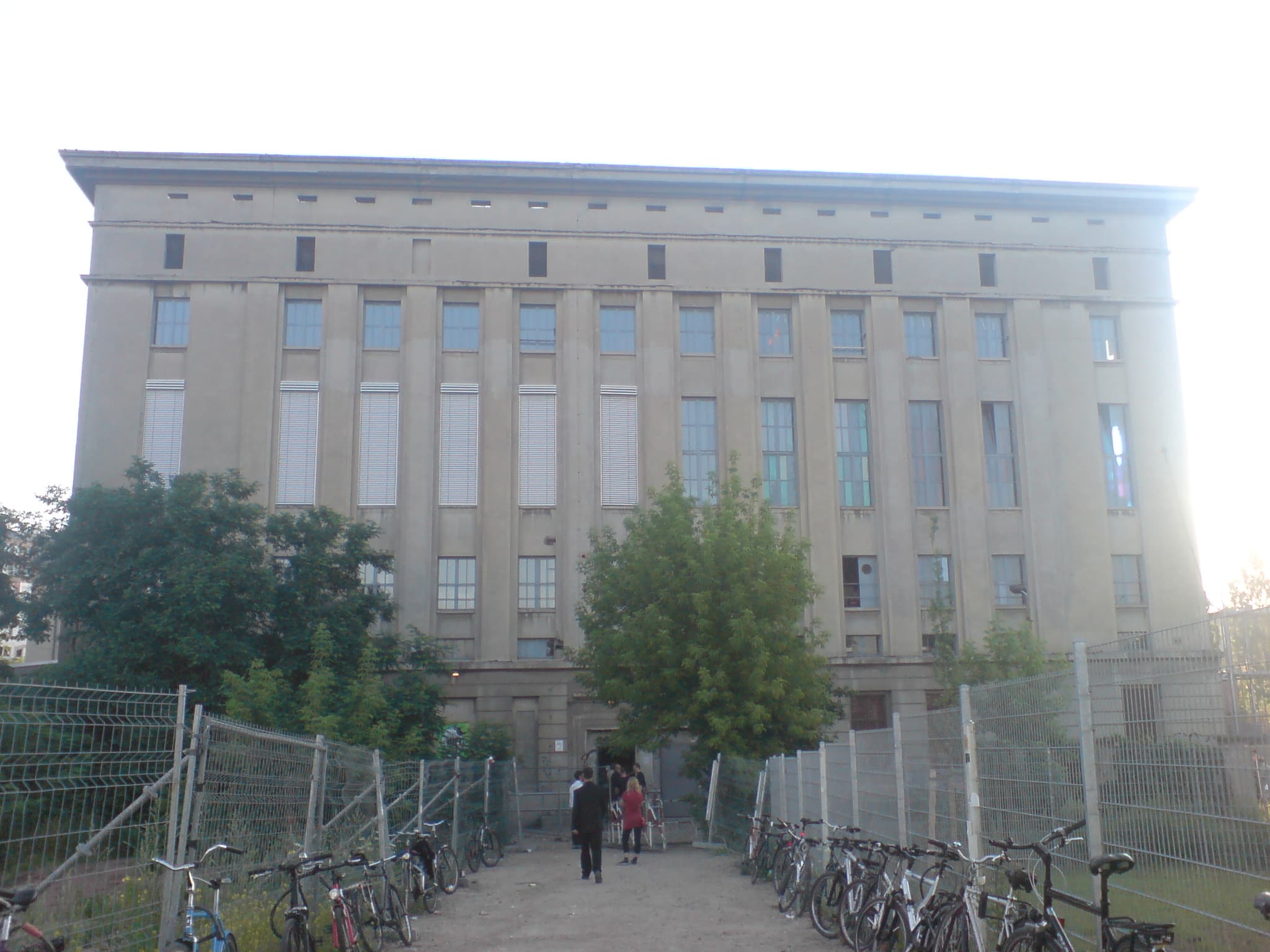
From the gravel forecourt at Am Wriezener Bahnhof you are looking at a Heizkraftwerk — a combined heat and power plant built in 1953 and 1954 as part of the Stalinallee project, meant to heat the flats of the new socialist working class. Read the building: the windowless slab, the small deep-set windows near the top where Panorama Bar sits, the queue running along the fence, often for hours, and the total absence of any sign telling you what this is. The plant was abandoned in the 1980s. In 2004 Norbert Thormann and Michael Teufele, who had run the club Ostgut in a postal depot nearby until it was demolished for the arena, took the shell on with architects Alexandra Erhard and Thomas Karsten of Studio Karhard and changed almost nothing: eighteen-metre walls, exposed rebar, raw concrete. Berghain opened on 15 October 2004. The name is a compound of Kreuzberg and Friedrichshain, the two districts the first crowd came from. Klubnacht runs from Saturday night through to Monday morning. Phone cameras are taped over at the door, so effectively no photographs of the inside exist. The door, worked by Sven Marquardt, refuses more people than it admits and is not worth trying to game. In March 2024 Berlin techno was added to Germany's national inventory of intangible cultural heritage.
Reviews
No reviews yet
Be the first to share your experience