About this tour
A four-hour food-first walk through the Amsterdam tourists never see. Sanne, an Amsterdam-based food writer who is genuinely annoyed that everyone goes to the Heineken Experience, takes you through De Pijp and the Jordaan for stroopwafels at Rudi's on Albert Cuyp Market, Surinamese roti at Warung Spang Makandra, colonial-era rijsttafel at Tempo Doeloe, deep-dish appeltaart at Winkel 43, and raw Hollandse Nieuwe herring at Stubbe's on the Singel — then across the IJ on the free NDSM ferry, framed as the best view in the city, to finish at Pllek on the old shipyard. Every spot named, every dish named, every immigration story told.
This tour is free thanks to our sponsors.
Subscribe to remove adsStops on this tour
- 1
Rudi's Original Stroopwafels — Albert Cuypmarkt
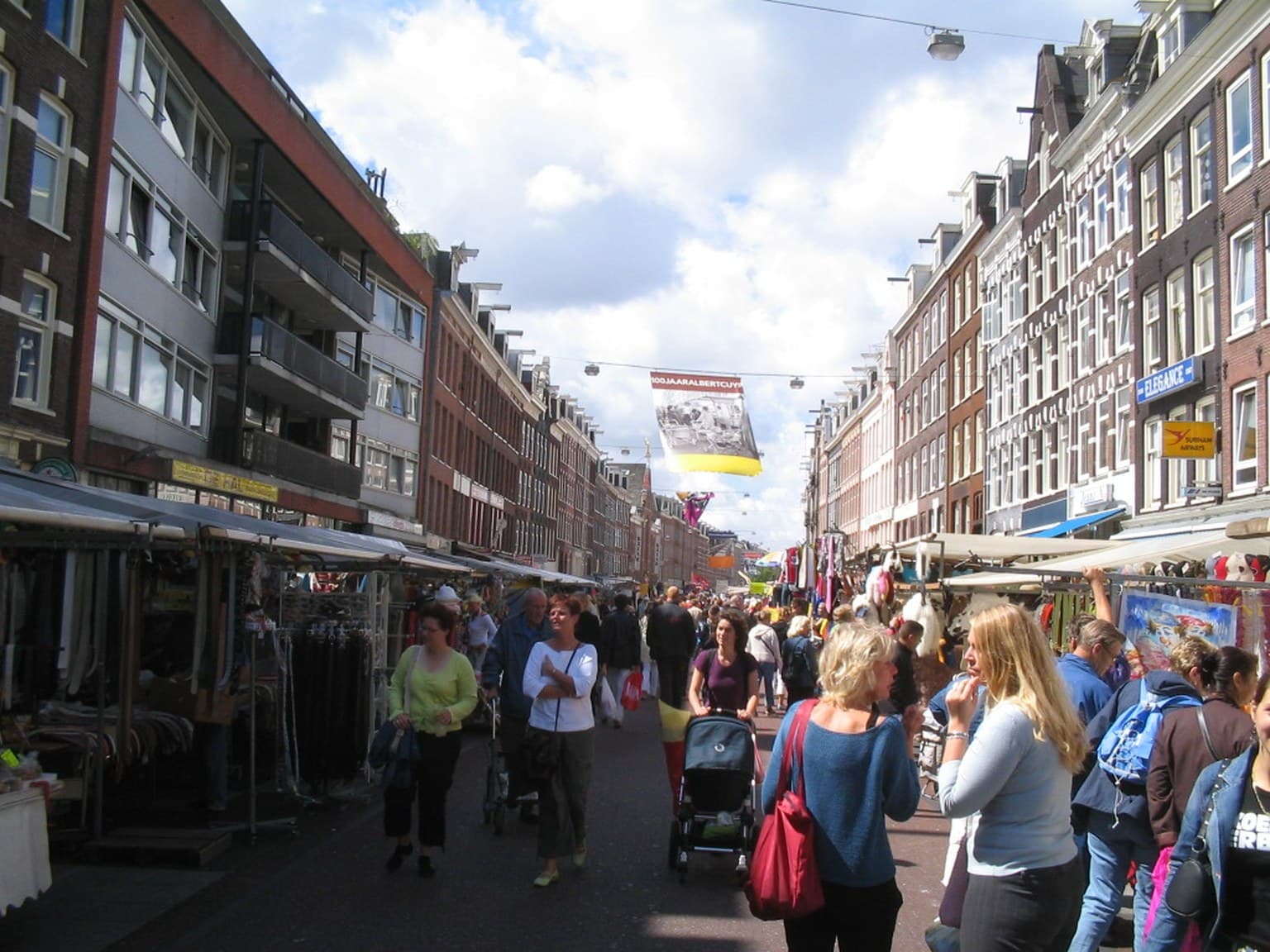
Face the building with the gilded angel on its roof: that is Brouwerij de Engel, Albert Cuypstraat 182. Rudi's Original Stroopwafels is stall 134, directly opposite, and you will smell the irons before you see the sign. Ask for one fresh stroopwafel, pressed to order, roughly two to three euros. Two paper-thin waffle halves come off a cast-iron press and are folded around a ribbon of caramel syrup that has not set yet; it arrives in a paper square, warm and sagging. You have about ninety seconds before the syrup stiffens, so eat it standing at the stall. Do not settle for the shrink-wrapped supermarket disc instead: that is a different food. The stroopwafel was invented in Gouda, about fifty kilometres south, around 1810 by a baker named Gerard Kamphuisen, out of leftover crumbs and syrup sold cheap to workers. The market around you opened in 1905 and still runs Monday to Saturday, roughly nine to five, closed Sunday: something like 260 stalls of fish, cheese, olives, Moroccan bread, Turkish spices and Surinamese sambal in little plastic tubs. The thing you can verify with your own eyes is who is shopping. Look for the De Pijp grandmothers with wheeled trolleys buying groceries rather than souvenirs. That is how you know the market is still working and not performing.
- 2
Warung Spang Makandra
Gerard Doustraat 39, a narrow storefront with maybe twenty seats and, if you have timed it well, a short queue on the pavement. No reservations, ever, so you wait. Open since 1978 and family-run the whole time. Say roti kip. What arrives is a warm, soft, paper-thin Surinamese flatbread the size of a dinner plate, folded beside a bowl of bone-in chicken curry stained deep yellow with turmeric and masala, plus long beans, masala potatoes, a hard-boiled egg and a small dish of sambal. Expect roughly ten to thirteen euros. You tear the roti with your hands and scoop; there is no cutlery ceremony here. Put the sambal on the plate rather than into the curry until you know what you are dealing with. If you do not eat meat, ask for roti groente, the vegetable version. If you want the rest of the menu, saoto soup, bami and moksi meti are the dishes the regulars order. Spang Makandra is Sranan Tongo, the creole of Suriname, and it means together. That word is the whole point of this stop. Suriname was Dutch for three centuries: sugar plantations, slavery, then indentured labourers shipped in from India and from Java after abolition. Independence came on 25 November 1975, and in the months around it roughly a third of the country's population moved to the Netherlands. Roti, bara, pom and saoto came with them.
- 3
Tempo Doeloe
Utrechtsestraat 75, on the narrow one-tram street where every shopfront is independent. There is nothing to push: the door is locked and you ring the bell to be let in. Book ahead, days ahead for a weekend, because they will not seat walk-ins. Opened 1981, Michelin Bib Gourmand. The order is the rijsttafel istimewa, twenty-five small dishes set around a central mound of white rice; budget somewhere in the range of forty-five to fifty-five euros a head before drinks, and expect waiters to keep arriving with plates for a good ten minutes. Look for rendang, beef braised in coconut milk until it goes almost black and collapses under a spoon; sambal goreng buncis, long beans in a smoky chilli sauce; ayam smoor, sweet soy-braised chicken; gado-gado; sayur lodeh; sate babi; and krupuk. If you are heat-shy, say so when you order, because the sambals here are not decorative. Method: a spoonful of rice, a spoonful of one dish, rice again, and work your way around the table. The uncomfortable part is the format itself. Rijsttafel, rice table, is not an Indonesian tradition. It is a Dutch colonial one, invented by wealthy families in Batavia, now Jakarta, who had their Indonesian cooks send out many dishes at once to impress guests. Indonesia declared independence on 17 August 1945; the Netherlands recognised it on 27 December 1949; around three hundred thousand Indische Nederlanders repatriated, and many of them opened restaurants.
- 4
Winkel 43 — Noordermarkt
The corner café on the triangular square is Noordermarkt 43, with the brick bulk of the Noorderkerk behind you. Order at the counter: exactly one slice of appeltaart and one coffee, roughly five to six euros for the slice and around three for the koffie. Dutch appeltaart is not the flat pie you are picturing. It is built tall in a springform tin, with a thick buttery almost-sablé crust pressed up the sides, packed with big chunks of Elstar apple, cinnamon, raisins and a whisper of lemon, and baked until the fruit slumps. It comes with a mountain of slagroom, barely sweetened whipped cream, piled beside it rather than on top. Take every forkful with cream; that is the whole trick. Winkel sells something like six hundred slices a day, so the pie itself is never the queue, the table is. The pavement stools facing the square are the better seat anyway. Time your arrival: Saturday morning the Boerenmarkt farmers' market wraps around the square with cheese, tulips, smoked fish and mushrooms the size of a fist, and Monday morning brings the Lapjesmarkt, the fabric market, held on this square for over three hundred years. The Jordaan around you was laid out in the 1610s as the cheap half of the canal expansion, for Huguenot and Jewish refugees, dock workers and shop girls. Read the street names: flowers and trees, the planners' compensation for six people to a room.
- 5
Stubbe's Haring
A small white and blue haringkraam parked on the Haarlemmersluis bridge where Haarlemmerstraat runs out onto the Singel: Singel 8, glass counter, a man in a white apron with a very sharp knife. Ask for een Hollandse Nieuwe met uitjes, roughly four to six euros, or a broodje haring, the same fish chopped into a soft white bun, for a euro or two more. Now the distinction most guidebooks blur. The Amsterdam way is to have the herring cut into bite-sized pieces on a paper tray, scattered with raw onion, with sliced pickle alongside, eaten with a little flag-topped cocktail fork. The tail-in-the-fingers, head-tipped-all-the-way-back swallow is the Rotterdam way. Either is correct; just know which one you are asking for, and if you want the whole fish here, ask for it heel. Hollandse Nieuwe means the young fish of the new season, landed from around the start of June, fat enough to taste mild, sweet and almost buttery rather than fishy. The season opens with Vlaggetjesdag, Little Flags Day, in the fishing harbour at Scheveningen, where the first barrel of the catch is auctioned for charity. The fish is why this city is here at all: in the late Middle Ages the Zeeland fisherman Willem Beukelszoon worked out how to gib a herring at sea, gutting it in one cut and packing it in salt, which let Dutch fleets stay out for weeks. Amsterdam is gebouwd op haringgraten. Built on herring bones.
- 6
Pllek — NDSM Wharf
Off the ferry at NDSM, turn left and follow the waterfront for about three minutes past the old shipyard cranes. Pllek is the long low building of stacked shipping containers at Tt. Neveritaweg 59, driftwood tables spilling onto a man-made sand beach at the edge of the IJ. Take a table on the water side. Order the beet hummus with dukkah and flatbread, the pan-fried North Sea cod if the kitchen has it, or the portobello burger with kimchi mayo, which is genuinely good rather than dutifully meatless; small plates run into the low teens in euros. Drink natural wine or a Texels beer. Getting here is half the stop: GVB line F4 leaves from De Ruijterkade, on the water side behind Centraal Station, takes about fourteen minutes, runs every fifteen to thirty minutes, takes bikes, and costs nothing at all. There is no barrier and no ticket. Stand on the open deck, not inside, and look up: with no hills, the sky is roughly half of Amsterdam. You are eating on what was once the largest shipyard in the world. The Nederlandsche Dok en Scheepsbouw Maatschappij employed thousands here in the 1950s building oil tankers, went bankrupt in 1984, and was left to rust. Squatters, painters, sculptors, metalworkers and circus performers took the empty halls and made Europe's largest artist colony, and the city eventually legitimised them instead of evicting them. Pllek opened in 2011 inside containers already sitting on the dock.
Reviews
No reviews yet
Be the first to share your experience