About this tour
Four and a half hours through the Rome the guidebooks route around. It begins in Campo de' Fiori, on the paving where the Inquisition burned Giordano Bruno alive on 17 February 1600 after pinning his tongue with an iron spike, and it ends on the Tiber embankment at dusk with a question. In between: the palace a family bought with a fifteen-year-old girl and paid for in stone stripped from the Colosseum; the bridge where 22-year-old Beatrice Cenci was beheaded in front of a crowd so dense that people fell into the river and drowned; the castle where a pope hid for six months while his city was sacked; a plate of cacio e pepe in the district built on a mountain of Roman rubbish; and six low rooms decorated with the bones of 3,700 friars who have one sentence for you. It names names and it gives dates. It is not for everyone.
This tour is free thanks to our sponsors.
Subscribe to remove adsStops on this tour
- 1
Campo de' Fiori
The statue is bronze, hooded and deliberately unheroic: no sword, no raised arm, just a man in a Dominican cowl holding a closed book, facing west down the line toward the Vatican. Ettore Ferrari made it, and it was unveiled on 9 June 1889 by Italian freethinkers after the Vatican had lobbied hard to stop it. Walk a slow circle around the plinth. The front inscription reads A BRUNO - IL SECOLO DA LUI DIVINATO - QUI DOVE IL ROGO ARSE, to Bruno, from the century he foresaw, here where the pyre burned. Around the base are portrait medallions of other people the Inquisition and the Reformation-era courts destroyed, among them Jan Hus, John Wycliffe and Michael Servetus, so Bruno is standing in company. Beneath his feet is the ground where he burned at dawn on 17 February 1600, in a Jubilee year with the city full of pilgrims, after seven years in Inquisition cells and a prosecution led by Cardinal Robert Bellarmine, the same Bellarmine who later warned Galileo off. Practicalities: the square is a fruit, vegetable and flower market in the morning, roughly until early afternoon, Monday to Saturday, then it is hosed down and handed over to the bars. Look around the perimeter and you will notice something else about this piazza - there is no church on it, the only major square in Rome with none. On 17 February there are fresh flowers at his feet.
- 2
Palazzo Farnese
Stand back in the middle of Piazza Farnese so the whole front fits in your eye at once: thirteen bays wide, three storeys, and along the roofline a cornice so deep it casts its own band of shadow down the façade. That overhang is Michelangelo's, added after Antonio da Sangallo the Younger died in 1546, and so is the central first-floor window with the Farnese lilies over it. The two huge granite tubs doing duty as fountains in the square are not ornaments: they were hauled out of the Baths of Caracalla. The travertine in the wall in front of you was quarried, under papal licence, from the Colosseum and the Theatre of Marcellus - the family dismantled ancient Rome to build a house. Alessandro Farnese started it in 1517 and became Pope Paul III in 1534. He had been made a cardinal in 1493, aged 25 and unqualified, while his fifteen-year-old sister Giulia Farnese was mistress to Alexander VI; Romans called him Cardinale della gonnella, the Petticoat Cardinal. His illegitimate son Pier Luigi, Duke of Parma, was stabbed by his own nobles at Piacenza on 10 September 1547 and thrown out of a window. The building has been the French Embassy since a 99-year lease signed in 1936. Annibale Carracci's ceiling in the Galleria is inside; visits are free but must be booked well in advance through the embassy, with photo ID.
- 3
Castel Sant'Angelo
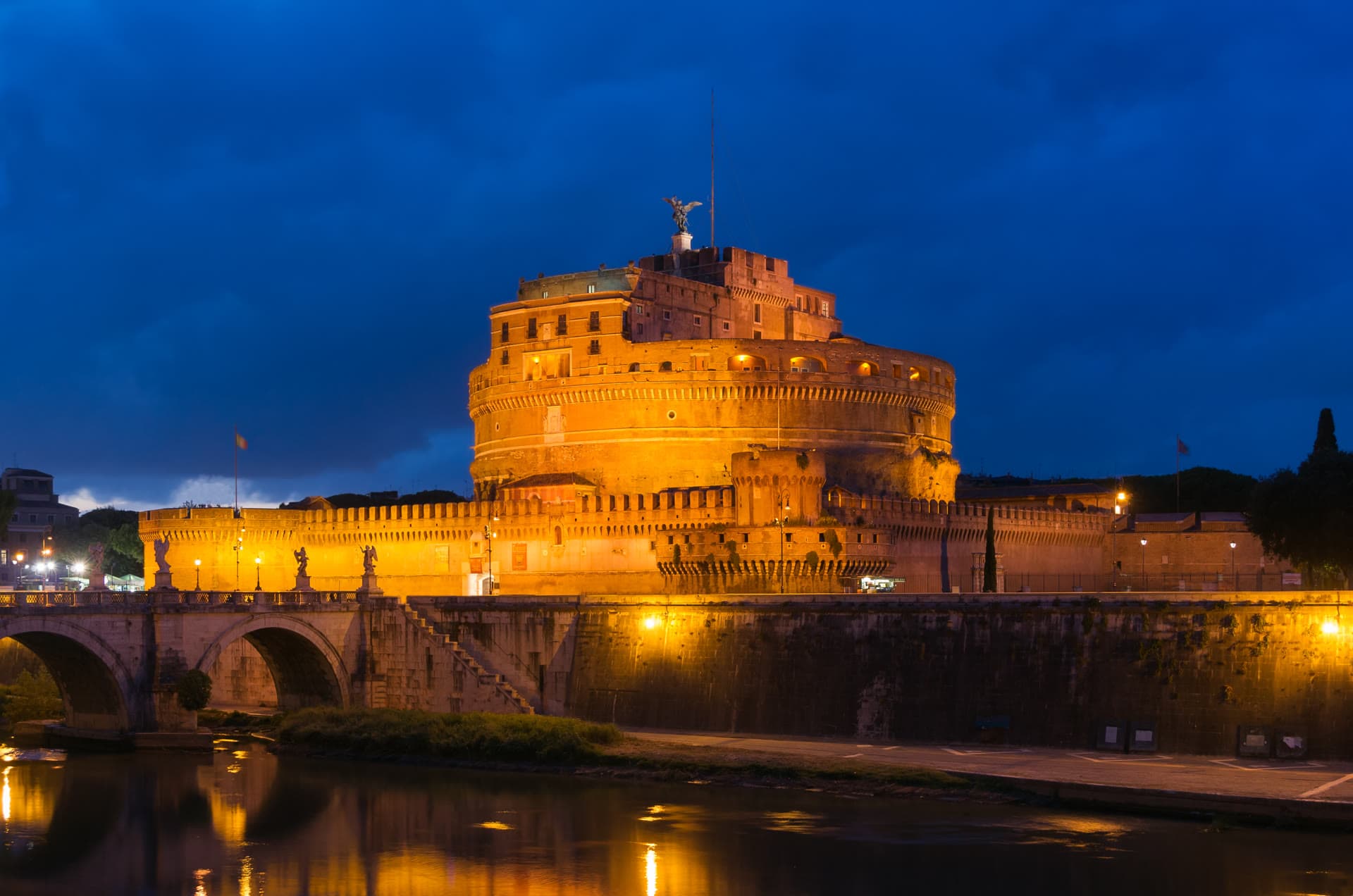
You are on Ponte Sant'Angelo, and the ten angels along the parapet are each carrying an instrument of the Passion - the column, the scourge, the crown of thorns, the nails, the lance, the sponge. Bernini designed the set in 1668. Two he carved himself; those two are copies, because the originals were moved indoors to Sant'Andrea delle Fratte. Ahead of you, the great cylinder is Hadrian's mausoleum, begun in 123 AD - everything above and around it, the bastions and ramparts and papal apartments, is eighteen centuries of building on top of a tomb, and the bronze archangel on the roof sheathing his sword is Pieter Verschaffelt's, 1753. Now find the Passetto di Borgo, the covered wall-walk running in from the Vatican. Clement VII ran along it on 6 May 1527 while 147 of the 189 Swiss Guards on duty died covering him, and then sat inside for six months with thirteen cardinals and about a thousand people. Benvenuto Cellini went down that outer wall on knotted bedsheets in 1539, broke his leg when the rope ran short, and told the story himself in his autobiography. At dawn on 11 September 1599, on the stones where you are standing, Beatrice Cenci was beheaded at 22, after her stepmother Lucrezia and before her brother Giacomo. Inside the castle, the first thing you climb is Hadrian's original spiral funeral ramp.
- 4
Felice a Testaccio
Via Mastro Giorgio 29, Testaccio. The thing to watch for is a waiter arriving at your table with a steel bowl and a long fork, because here the cacio e pepe is mantecato al tavolo - finished in front of you, roughly ninety seconds of very fast wrist work to emulsify grated pecorino romano, coarse black pepper and starchy pasta water into a sauce around fresh tonnarelli. Tonnarelli are square-cut egg pasta, thicker and rougher than spaghetti, and the roughness is the entire point: it has to hold a sauce that contains no cream, no butter, no oil and nothing at all from outside the old world. If the cheese seizes into a rubbery lump there is nothing to hide behind, which is why Romans use this one dish to judge a kitchen. The trattoria has been in Trivelloni hands since 1936, when Felice Trivelloni took over his father Guido's osteria, and Romans still swear he once turned Sophia Loren away at the door - almost certainly a story, and nobody in Testaccio will let you say so. If you have room, order coda alla vaccinara as well: oxtail stewed long with celery, the emblem of the quinto quarto, the fifth quarter of the animal that the workers at the old Mattatoio a few streets from here took home as part of their pay. Book ahead. Afterwards walk to Monte Testaccio, a 35-metre hill made entirely of smashed olive-oil amphorae dumped between the first and third centuries AD - look at the cut banks and you can see the terracotta shards.
- 5
Capuchin Crypt - Santa Maria della Concezione
Via Vittorio Veneto 27, up a short flight of steps on the right as you come from Piazza Barberini. From the pavement it reads as a plain parish church and most people walk straight past it. Upstairs in the church there is Guido Reni's Archangel Michael and a Saint Francis in Meditation long attributed to Caravaggio - ten minutes, worth it. What you came for is underneath, reached through the museum: six low rooms, five of them decorated in the bones of about 3,700 Capuchin friars who died between 1528 and 1870. The arranging began in 1631, after Cardinal Antonio Barberini, brother of Pope Urban VIII, had the remains carted here from the friars' old convent near the Trevi Fountain. The rooms are named for their materials: the Crypt of the Skulls, the Crypt of the Pelvises, the Crypt of the Leg Bones and Thigh Bones, the Crypt of the Three Skeletons, and the Mass Chapel. Look up as you go - the light fittings are built from vertebrae, the arches from femurs, and whole friars stand in their brown habits in the niches. The plaque at the end, in Italian and four other languages, reads Quello che voi siete noi eravamo; quello che noi siamo voi sarete: what you are now we once were, what we are now you will be. No photography anywhere below. Mark Twain came in 1867 and put it in The Innocents Abroad; the Marquis de Sade got here first, in 1775.
- 6
The Tiber at Dusk
Lungotevere Castello, on the stone parapet just upstream of Ponte Sant'Angelo, facing west. What is in front of you: the ten Bernini angels going to silhouette on the bridge, Castel Sant'Angelo to the right of them, and beyond that the dome of St Peter's, which from this angle turns black against the sun rather than gold. The bridge is closed to traffic, so you can walk out and stand in the middle of it. Then look down at the wall you are leaning on. These embankments are the muraglioni, begun in 1876 after the flood of 28 December 1870 put the Tiber through the centre of Rome; before them the river came up to the house fronts and the city flooded again and again. The same engineering that gave you this view is what cut Rome off from its own water. And then the arithmetic of the day. Giordano Bruno's ashes went into this river in February 1600. Beatrice Cenci was beheaded at dawn on 11 September 1599 on the bridge in front of you, and people in the crowd fell off it and drowned. Clement VII ran above this stretch along the Passetto on 6 May 1527. Cellini fell toward this bank in 1539. The last half-hour before sunset is the light you want. Nobody is going to ask you for an answer to the question.
Reviews
No reviews yet
Be the first to share your experience