About this tour
Four hours from Monastiraki through Psyrri to Exarcheia and back, with Eleni, an Athenian activist and art-history graduate, reading the city's walls as the front page of a newspaper Greece never printed. Cacao Rocks's Lord Byron on Tombazi, painted in December 2021. The iNO corridor on Sarri Street from the crisis years. A chess kafeneio on Mavromichali where Garry Kasparov played thirty boards in 1992 and lost none. Parko Navarinou, a car park the neighbourhood dug up and planted in March 2009, and the corner a block away where a fifteen-year-old boy was shot dead in December 2008. It ends where it starts, under the Acropolis, with an argument about what democracy actually sounds like. Street art is perishable: some of what is named here will have been painted over by the time you walk it, and that is part of the point.
This tour is free thanks to our sponsors.
Subscribe to remove adsStops on this tour
- 1
Monastiraki — Reading the Palimpsest
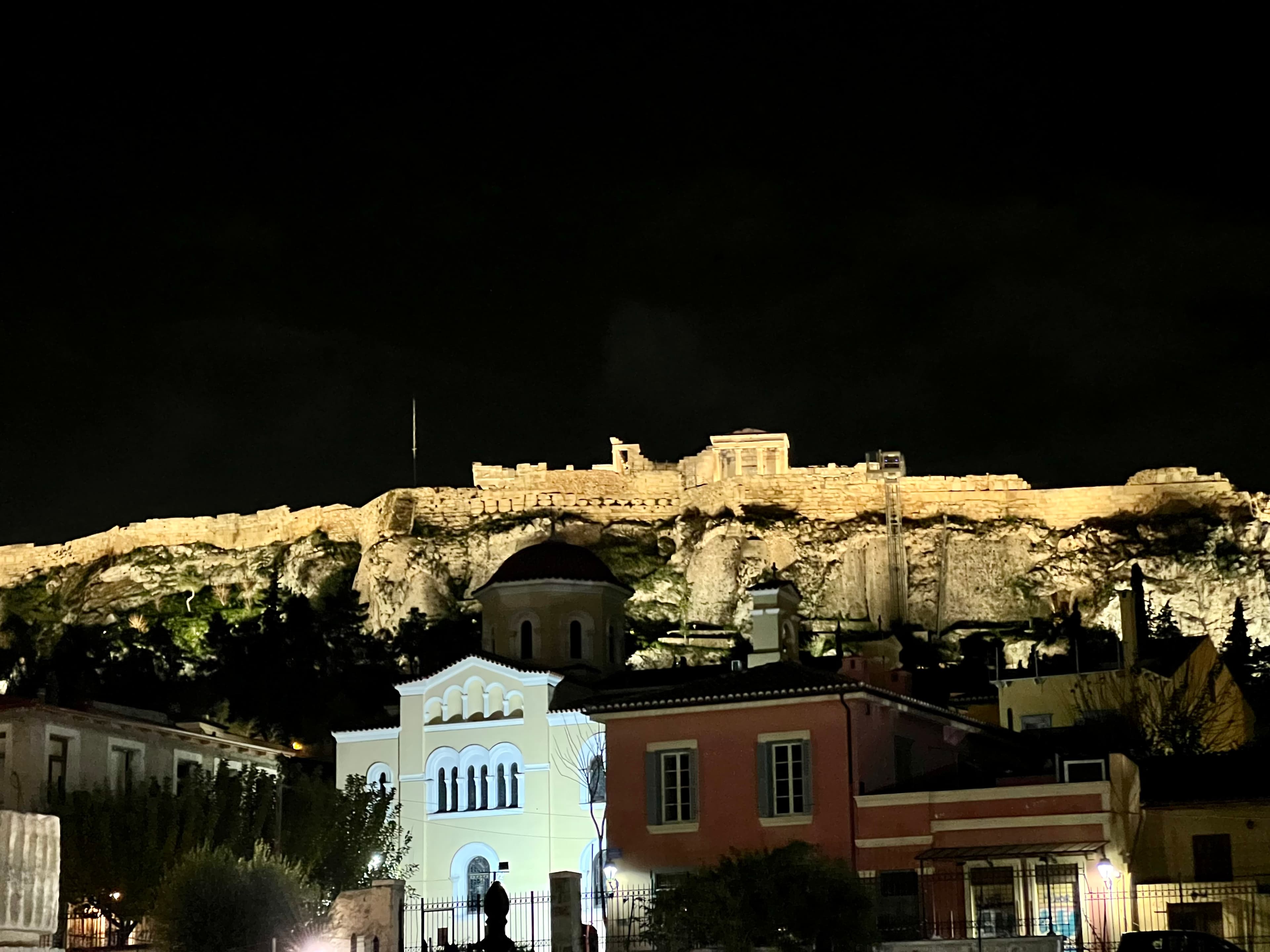
Start at the glass panels set into the paving near the metro entrance: through them you can see the channelled bed of the Eridanos, the small river that has run under this city since antiquity, and the footings of Roman-era shops. Then turn a slow circle. The small pink-domed building is the Tzistarakis Mosque, built in 1759 under Ottoman rule. The tall marble wall on the eastern edge belongs to Hadrian's Library, finished around AD 132. Above and to the left, the Acropolis. Four regimes stacked in one square, each one built on the last. Palimpsest is the art-history word for a manuscript scraped clean and written over, where the older text still shows through when you hold it to the light. Carry that word for the next four hours, because it is exactly how a wall works here: nothing is erased cleanly, and the layer underneath is usually still legible. Before you leave, do one thing. Step into any of the lanes running north towards Psyrri — Pandrosou, Ifestou, Normanou — and look at the roller shutters, the doorframes, the utility boxes. Tags, stickers, a stencil or two. Even the most photographed square in Athens is already talking. The question this walk asks is the one to carry from here to Exarcheia and back: when a city stops believing its newspapers, where does it print? You get the answer in this same square, four hours from now.
- 2
Cacao Rocks — Lord Byron in Psyrri
The junction of Tombazi and Leocharous in Psyrri, two storeys of blind wall: dark curls, a high Romantic collar, the eyes roughly level with the third-floor balconies opposite. The mural went up in December 2021, signed Cacao Rocks, the working name of Yassonas Megoulas — born in Athens, raised on Corfu, half Greek and half French, painting walls since he was twelve, and still keeping a studio a few streets from here at Block Art in Psyrri. It was commissioned in the run-up to the two-hundredth anniversary of the 1821 revolution, which is the point of it: of all the faces available for that anniversary, the one that got this wall is a foreigner's. Byron sold his English estate in 1823, raised and paid for a militia, sailed to Missolonghi on the swampy west coast, and died there of fever in April 1824, aged thirty-six, without seeing Greece free. Athens gave him a street, a whole suburb (Vyronas, the Greek form of his name) and now this. Two things to check with your own eyes. First, the paint itself: an outdoor mural in Psyrri lasts exactly as long as the building and the landlord allow, and this one is already several years old, so if the wall is blank, tagged over or repainted, you are looking straight at the rule this tour is about. Second, everything smaller around it — paste-ups, a shutter piece, tags — almost all of it newer than the Byron, and none of it commissioned.
- 3
Sarri Street — iNO and the Last Supper of the Crisis
Sarri Street is the densest single block of large-format mural work in central Athens: blind side-walls left standing when neighbouring buildings came down, four to six storeys, painted end to end. The enormous monochrome figures in blue, grey and white are by iNO, a graduate of the Athens School of Fine Arts who keeps his legal name out of circulation; his piece Breaking Barriers of Equality stands at the start of the street. WD and Alexandros Vasmoulakis have work in the same corridor. The murals here date roughly from 2012 to 2016, and the individual attributions and dates are genuinely contested between sources, so treat any single caption you read about this street, including this one, as approximate — and expect gaps where pieces have gone. The context for all of it is 2010, the year Greece ran out of money, signed a memorandum with the IMF, the European Commission and the European Central Bank, and in exchange for emergency loans cut pensions and public wages until youth unemployment passed fifty-five per cent. iNO's best-known work is not on this street. It is his reworking of Leonardo's Last Supper, painted in 2019 for the 500 Years of Genius exhibition at the Old Depot in Gazi, off Piraeus Street: the central seat empty, the ministers around the table dozing or taking money, hands rising from below that nobody takes, the Acropolis behind them. Seeing it is a separate trip west, and like everything here it is not guaranteed to still be up.
- 4
Kafeneio Panellinion — Chess Against Gentrification
Mavromichali 16, on the Exarcheia edge: yellow walls, fluorescent tubes, eight or nine tables, a chess board on nearly every one, and almost no sound except wooden pieces and small cups going down on saucers. This is Kafeneio Panellinion, and a kafeneio is not a café. It is the Greek civic room invented in the 1830s, where working men read the newspapers aloud to each other, argued, and worked out what the neighbourhood thought. The most famous of them, Orea Ellas — Beautiful Greece — was effectively a parliament without a building in 1860s Athens. Panellinion's speciality is chess, and the house rule is that you play and you keep your voice down. In August 1992 Garry Kasparov, then world champion, played a thirty-board simultaneous exhibition here against the regulars and won all thirty; some of the men in the room now were in the room that night. Practicalities: order a Greek coffee and say metrio, medium-sweet, which is the safe default; it costs a couple of euros; bring cash. Do not photograph the players without asking first. The reason a chess café sits in a street-art tour is timing. Gentrification is a speed — it needs turnover, the same room becoming three things in three months — and this room refuses to become anything else, in a district where the new metro works, the short-let flats and the wine bars are all arriving at once. The boards in here and the walls outside are making the same argument at different volumes.
- 5
Navarinou Park and the Corner Where Alexis Died
You are at Parko Navarinou, on the block between Navarinou and Charilaou Trikoupi. It is not a municipal park. On 7 March 2009 residents of Exarcheia walked onto what was legally a car park belonging to the Technical Chamber of Greece, broke up the asphalt and planted it: vegetable beds, trees, a playground, free films in summer. It has been run by an open assembly ever since, with no director and no budget. The sign read: their parking, our park. Three months before that, one block to the north-east at the corner of Tzavella and Mesolongiou, a fifteen-year-old named Alexandros Grigoropoulos was shot dead by Epaminondas Korkoneas, a special guard of the Greek police, on the night of Saturday 6 December 2008. Police first said the shot had ricocheted. It had not, and Korkoneas was convicted of murder. Within days protests had spread to every major Greek city — the largest civic uprising since the fall of the junta in 1974. The memorial at that corner is concrete and marble, rebuilt by volunteers in 2022, and there are usually fresh flowers on it; people gather there every 6 December. If you walk over, go quietly. The stencilled portraits of Alexis around Exarcheia are largely the work of the crew Political Stencil, and the painted wall on Tzavella is repainted by the neighbourhood as it fades. The very large mural overlooking this park is widely credited to the Italian artist BLU, but that attribution comes from travel press and could not be confirmed as still standing.
- 6
Back to Monastiraki — Two Kinds of Democracy
Same square, same flea market, same metro entrance, four hours later. Put your back to the mosque and look up: the Acropolis, and beyond it to the west the low bare hill of the Pnyx, where the Athenian assembly actually met. Demos, people. Kratos, power. Citizens stood on a stone platform in the open air, unedited, without a fee, and the city had to hear them; the assembly met there roughly forty times a year and the platform was open to any citizen who wanted it. That is the answer to the question you were asked in this square at the start. When a city stops believing its newspapers, it prints on the only surface it still owns outright. The iNO figures on Sarri, the Byron on Tombazi, the stencils of a fifteen-year-old boy on Tzavella, the men over the chess boards on Mavromichali, the residents who dug up a car park on Navarinou — none of that is the noisy alternative to the marble on the hill. It is the same practice with a different permission structure: a person with no microphone making themselves heard on a surface the city cannot un-see. One last instruction, and it is free. Walk back through Psyrri slowly tonight, after the shops close and the shutters come down, and read the walls the way you read a front page — who painted this, when, what were they angry about, did it work. Most of what you saw today will be gone within a few years. That is not a flaw in the medium. That is the dateline.
Reviews
No reviews yet
Be the first to share your experience