About this tour
Five hours on foot through Staré Město and Josefov, with Franz Kafka as the lens and Prague as the patient. Stand on the square where he was born, climb the staircase at Assicurazioni Generali where he wrote the first paragraph of The Trial in his head, hear the dark medieval legend the Astronomical Clock crowds never learn, visit the Old-New Synagogue where a clay man supposedly still sleeps in the attic, drink a real Pilsner at Hrabal's pivnice U Zlatého Tygra (we'll teach you how to order in Czech), and end by the Vltava on Kampa Island with the story of how Kafka asked for his work to be burned — and the friend who, out of love, disobeyed. Literary, dry, slightly melancholic. The kind of tour that makes you re-read The Trial the moment you get back to your hotel.
This tour is free thanks to our sponsors.
Subscribe to remove adsStops on this tour
- 1
Kafka's Birthplace — Náměstí Franze Kafky
The plaque on the corner of Maiselova and U Radnice carries a bronze head with a small moustache and permanently startled eyes. Franz Kafka was born in the house on this corner on 3 July 1883 and circumcised in the same apartment eight days later; his father Hermann, a loud self-made shopkeeper from a Czech-speaking village, noted in the family book that the boy looked healthy. The building is the first joke of the day. The original was a Baroque corner house called U Věže, the House at the Tower, named for the tower of the St. Nicholas church behind you. It came down in 1897, when the Habsburg authorities declared Josefov unhygienic and demolished more than six hundred buildings to cut wide Parisian avenues through the ghetto. Kafka was fourteen, walking to school through a neighbourhood being erased around him. The replica in front of you stands a few metres back from the original footprint and is taller than the house it replaces, with the old Baroque portal and balcony bolted onto the new stone like a relic — find the join, it is visible from the pavement. The ground floor holds a small exhibition, the Expozice Franze Kafky. The square has been called Náměstí Franze Kafky only since 2000; for the first century after his birth, the man born here had no address in his own city.
- 2
Old Town Hall & the Astronomical Clock
The Orloj is mounted on the south wall of the Old Town Hall on Staroměstské náměstí. The astronomical dial was built in 1410 by the horologist Mikuláš of Kadaň to a design by Jan Šindel, professor of astronomy at Charles University; the calendar dial below it and the Gothic figures were added around 1490 and are traditionally credited to Master Hanuš, whose real name was Jan Růže. On the hour a trapdoor opens above the dial, twelve wooden apostles pass two small windows, the skeleton on the right pulls its bell rope and a golden rooster crows. Mark Twain came, watched, and was unimpressed. Almost nobody in the crowd knows the story Czech children learn, written down by Alois Jirásek in Staré pověsti české: that the councillors of Prague, afraid Hanuš would build a finer clock for a rival city, sent men to hold him down one night and put a hot iron through his eyes; that Hanuš had himself carried into the tower, reached into the gears, stopped the clock and died inside it; and that for a hundred years nobody could repair it. Historians treat the blinding as a nineteenth-century accretion. Now look left of the tower at the open lawn where a building obviously used to be. The Old Town Hall's entire east wing stood there until German artillery burned it in the last days of the Prague Uprising in May 1945. The clock burned with it. The apostles you are watching are post-war replacements carved by Vojtěch Sucharda.
- 3
Assicurazioni Generali — Wenceslas Square 19
Václavské náměstí is not a square but a boulevard roughly 750 metres long, and number 19 sits on its lower, older half. This neoclassical palace held the Prague branch of Assicurazioni Generali, the Italian insurance house founded in Trieste in 1831. On 1 October 1907 a twenty-four-year-old law graduate named Franz Kafka came through this door for his first real job, hired as an Aushilfskraft — an auxiliary clerk — in the life-insurance department. He got in through a chain of favours running out of the city entirely: his uncle Alfred Löwy in Madrid, the man who ran the Madrid branch, and that man's father Arnold Weissberger, a former American vice-consul who knew the family. Kafka expected to be posted to the Trieste head office and started learning Italian. Only transport-insurance staff were ever sent abroad. He stayed in Prague. The hours were eight in the morning to six in the evening, with a dead two-hour break in the middle that made writing impossible, and he resigned on 31 July 1908, nine months in, for the semi-state Worker's Accident Insurance Institute, whose single shift ended in the early afternoon and gave him back the hours in which he wrote The Metamorphosis, The Trial and In the Penal Colony. Then look at the facade and notice what every column and cornice is arguing: that an institution built this solidly will always know where your file is. Josef K. is arrested by exactly this kind of building.
- 4
Café Arco — Hybernská & Dlážděná
The corner of Hybernská and Dlážděná, a couple of minutes from Masarykovo nádraží, Prague's oldest railway station. Café Arco opened here in 1907, the same autumn Kafka started at Generali across town, and it had three rooms: the main café, a billiard room, and a reading room stocked with newspapers from across Europe on wooden holders. The Viennese satirist Karl Kraus sneered at the regulars as the Arconauts and the name stuck. They were Max Brod, Franz Werfel, Felix Weltsch, Oskar Baum, Willy Haas, Egon Erwin Kisch, Ernst Polak, Paul Kornfeld and František Langer — the group Brod would later name Der Prager Kreis, the Prague Circle — and, most nights he could get away from the office, Kafka. It was in rooms like this that he read the opening of The Metamorphosis aloud and had to stop because he was laughing. Hold on to that. The man had a deadpan comic's timing and thought the story was funny. The other thing to feel on this corner is the language. Prague in 1910 was trilingual — Czech, German and Yiddish on the same trams and in the same families — and the German-speaking Jewish middle class was a small and shrinking share of a city becoming decisively Czech. Kafka wrote in a mother tongue that was quietly leaving the room, and the Arco was the room where it still felt permanent. The café itself has been closed, reopened, renovated and rebranded since. What has not changed is the corner, the two street names, and the three-room plan.
- 5
Old-New Synagogue & Josefov
Staronová synagoga stands on Maiselova, and you step down into it, because the medieval floor sits below today's street. Completed around 1270, it is the oldest synagogue in Europe still in use: a twin-nave Gothic hall whose vaults were built with five ribs instead of the structural four, so that the ceiling never forms a cross. The tall brick gable with its ladder of steps was added in the fifteenth century and is the silhouette in every Golem illustration ever printed. The building survived pogroms, the Thirty Years' War, the Habsburg clearance that levelled almost all of Josefov between 1893 and 1913, and the Second World War, when the Nazis kept the quarter intact as the intended museum of a people they meant to erase. On the outside wall, find the iron ladder that runs up to the attic; its lowest rungs are missing and the attic is sealed. What is up there is the community's genizah, its store of worn-out sacred books — or, in the legend first printed in Prague in 1847 in a collection called Galerie der Sippurim, the body of the Golem, shaped from Vltava clay by Rabbi Judah Loew ben Bezalel, the Maharal, chief rabbi under Rudolf II, brought to life by a shem placed in its mouth and laid up there under old prayer shawls when its work was done. The historical Maharal was a Talmudist, mathematician and astronomer, not a maker of clay men. It made no difference. By the time Kafka was a boy walking these streets to school, the Golem was already the groundwater of the quarter.
- 6
U Zlatého Tygra — a Real Pivnice
Husova 17, a small sign with a golden tiger, and behind the door a low vaulted room of long shared tables a couple of minutes from the Clementinum. U Zlatého Tygra is a pivnice — a beer hall, not a restaurant and certainly not a bar — and it pours one thing, Pilsner Urquell 12° from Plzeň, and has done for longer than most of its regulars have been alive. Bohumil Hrabal, who wrote Closely Watched Trains and I Served the King of England, drank here almost daily for decades at his own table. In January 1994 Václav Havel brought Bill Clinton here rather than to any state dining room. The etiquette is real and nowhere written down. You do not order a beer. You sit, share a table, say Dobrý den, and within half a minute one arrives with a paper coaster that the waiter marks with a tally line. Another appears as you near the bottom, then another. To stop, lay the coaster flat on top of the empty glass. That is the entire signal and nobody will take offence. It is cash only, there is an ATM around the corner, and the room opens in the mid-afternoon and fills within the hour, so come early if you want a seat. The words that matter: Dobrý den, hello; Jedno pivo, prosím, one beer please; Velké pivo, prosím, a large one; Na zdraví, cheers, literally to health; Děkuji, thank you; Zaplatím, prosím, I would like to pay. Eat something — nakládaný hermelín, camembert pickled in oil with onion and pepper, or utopenec, a pickled sausage whose name means the drowned man.
- 7
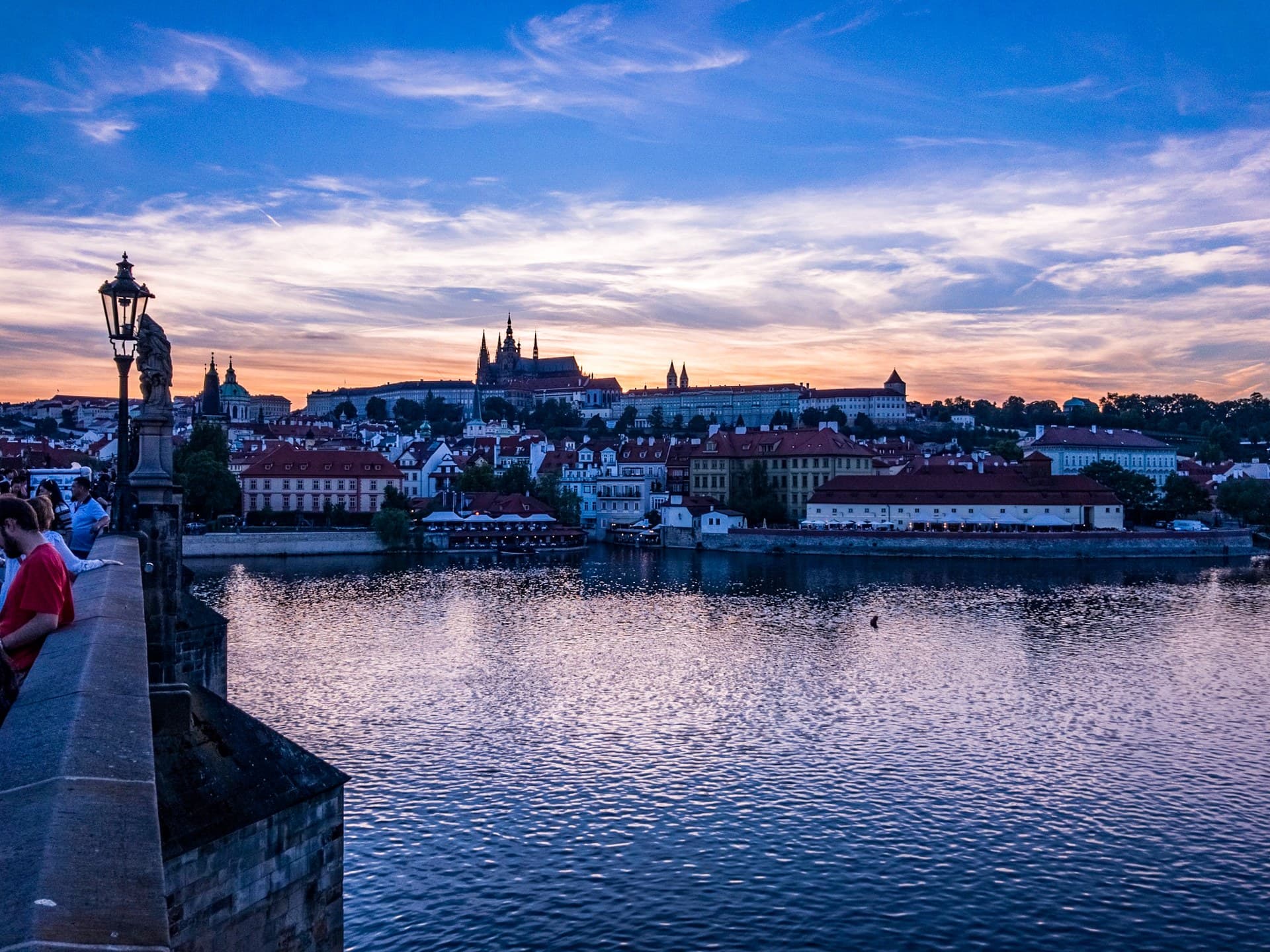
Kampa Island — the River
Take the stairs down from Charles Bridge on the Malá Strana side and you are on Kampa, an island cut off from the bank by the narrow Čertovka channel — look for the big wooden mill wheel at the Grand Priory mill, still turning. The Lennon Wall is a minute up the lane. The bench you want faces east across the Vltava at the Old Town skyline you started from this morning. In June 1924, in a sanatorium at Kierling outside Vienna, Franz Kafka died of laryngeal tuberculosis at forty. He could not eat and could barely speak above a whisper, and he spent his last weeks correcting the proofs of A Hunger Artist, a story about a man who starves himself in public because he never found a food he liked. Among his papers Max Brod found a note: everything left behind — diaries, manuscripts, letters both his own and others', sketches and so on — was to be burned unread and to the last page. Brod, his friend and editor for twenty years, read it and refused. He published The Trial in 1925, The Castle in 1926, and in 1927 the unfinished novel he titled Amerika, a name Kafka never gave it. In March 1939, as Germany occupied Bohemia, Brod left Prague on one of the last trains out with a case of unpublished manuscripts and got them to Palestine. Everything you have walked past today — the square, the museum, the bookshops, this bench — exists because one man disobeyed a dying friend's clearest instruction.
Reviews
No reviews yet
Be the first to share your experience