About this tour
Spend a slow Viennese afternoon with Herr Doktor Otto through four legendary Kaffeehäuser — Café Central where Trotsky played chess and Altenberg took his mail, Café Landtmann where Freud read his newspapers, Café Museum where Klimt argued with Loos, and Café Hawelka, the one room unchanged since 1939. Learn to order a Melange, a Verlängerter, a Großer Brauner, and an Einspänner. Eat Apfelstrudel, Sachertorte, and Frau Hawelka's Buchteln. Discover why the Viennese coffee house was the most important intellectual institution in early twentieth-century Europe — and why one unchanged room might be the most radical act of preservation in a city of palaces.
This tour is free thanks to our sponsors.
Subscribe to remove adsStops on this tour
- 1
Café Central
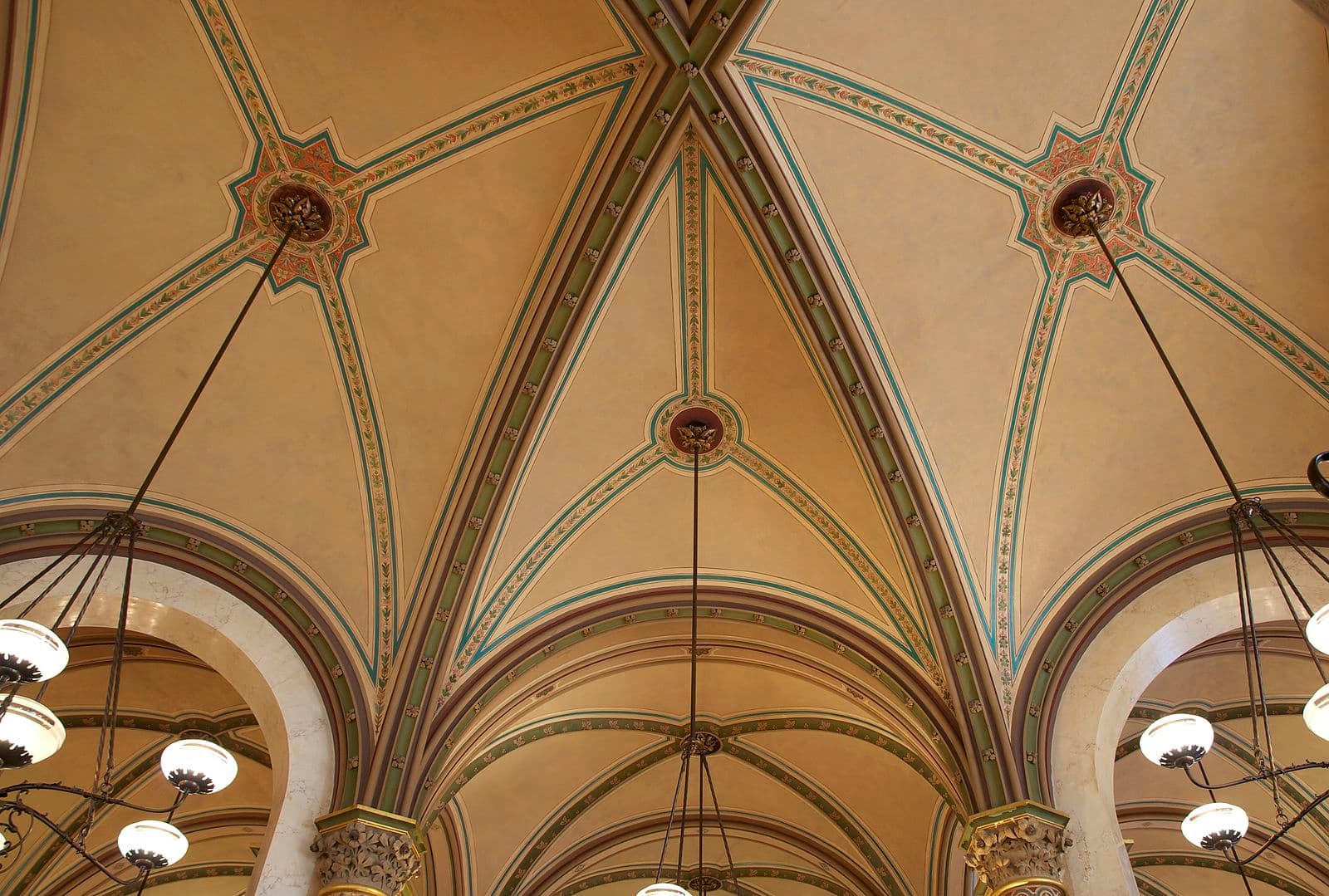
Enter from Herrengasse 14 through the arcade of Palais Ferstel — Heinrich von Ferstel also built the Votivkirche — and look up at the vaults and marble columns before you find a table. Café Central opened in 1876 and was nicknamed die Schachhochschule, the Chess University: chess was played at nearly every table. Just inside the door sits a papier-mâché figure of Peter Altenberg, the bohemian poet who could not afford an apartment and gave the post office this café as his home address; his letters arrived here. From 1907 to 1914 an exiled Russian called Lev Bronstein played chess here most afternoons. Warned of revolution in Russia, the foreign minister Count Berchtold is said to have asked who would lead it — Herr Bronstein, over there at the Café Central? Months later Bronstein, better known as Trotsky, was leading the Red Army. Karl Kraus edited his one-man magazine Die Fackel from these tables; Adolf Loos, Hugo von Hofmannsthal and Arthur Schnitzler were regulars. Order a Melange, about 4.80 euro: one espresso under steamed milk with a cap of foam, and not a cappuccino if a Viennese asks. With it, Original Wiener Apfelstrudel, about 6.90 euro, warm under icing sugar with unsweetened Schlagobers alongside; its paper-thin pulled Strudelteig descends from Ottoman filo technique left behind after the siege of 1683. Both arrive on a small silver tray beside a glass of Leitungswasser. The water is not decoration: the Ober refills it unasked for as long as you sit.
- 2
Café Landtmann
Universitätsring 4, the Burgtheater opposite, the University of Vienna a minute away. Franz Landtmann opened it on 4 October 1873, and it is the most formal room on this walk: red velvet banquettes, brass sconces and a Herr Ober in black tie carrying a silver tray. Sigmund Freud lived fifteen minutes away at Berggasse 19, now the Sigmund Freud Museum, and came here to do what a nineteenth-century Viennese gentleman did in public — read the newspapers. Die Neue Freie Presse, a cigar, a Melange, nothing to hurry to. He was not a daily fixture; he was a private man of rituals, and this was the one he performed in the open. Gustav Mahler, director of the Court Opera from 1897 to 1907, came after rehearsals; Thomas Mann, Max Reinhardt, Marlene Dietrich and Paul McCartney all sat here, and the guestbook is on display inside. Order a Großer Brauner, about 5 euro: a double espresso with a small cloud of milk or cream — enough to take the edge off, not enough to dilute it. Kleiner Brauner is the same drink with a single shot, and those two words are the whole difference. With it, Original Sachertorte with Schlagobers, about 8.90 euro. A sixteen-year-old apprentice named Franz Sacher invented it in 1832 for Prince Metternich's table when the head chef fell ill: dense chocolate sponge, a thin seam of apricot jam beneath the glaze, a firm dark chocolate top. It is deliberately dry, which is why the unsweetened cream is not optional and why the bitter Brauner is its right partner.
- 3
Café Museum
Operngasse 7, a short walk from the Secession building and its Beethoven Frieze by Klimt. Café Museum opened in 1899 and makes its argument the moment you are inside: no gilding, no plush, no velvet — bentwood Thonet chairs, plain marble, a bare ceiling. Adolf Loos designed it, nine years before he published Ornament and Crime, the essay claiming decoration was a moral failure and civilisation proves itself by stripping things to their function. Vienna was scandalised and nicknamed it Café Nihilismus. Loos took it as a compliment. Note, though: Josef Zotti remodelled the interior in the 1930s, and only a partial Loos restoration followed in 2003-2010. Gustav Klimt made the café an unofficial headquarters after he and the younger painters walked out of the Künstlerhaus in 1897 to found the Vienna Secession; it stands halfway between the Secession and the Academy. Egon Schiele, Oskar Kokoschka and Otto Wagner of the Postsparkasse followed; Robert Musil sat here in the 1920s writing The Man Without Qualities, Elias Canetti in the 1930s. Order a Verlängerter, about 5 euro — roughly fair-len-GAIR-ter, meaning lengthened: a single espresso pulled long with hot water, softer than an Americano, built to make one cup last ninety minutes. With it, Buchteln mit Vanillesauce, about 7.50 euro — yeast buns baked touching in a buttered pan so they tear apart like dinner rolls, filled with plum or apricot jam and flooded with warm vanilla sauce. The name is the Czech buchta.
- 4
Café Hawelka (Afternoon)
Dorotheergasse 6: a narrow door under a small sign, off the Graben past the Kohlmarkt. In the afternoon the front window does the lighting: a wedge of daylight across the marble, the back of the room in shadow. The room is the point: dark panelling, velvet banquettes patched where people have sat on them for eighty years, scratched marble tables, and newspapers on wooden holders you may keep at your table as long as you like. Leopold and Josefine Hawelka opened it in 1939. Leopold was conscripted into the Wehrmacht at once, Josefine held the place through the war, he came home in 1945 and they reopened together. The interior has not meaningfully changed since. Never modernised, it became the cheap refuge of post-war Vienna's writers and painters: Hundertwasser was a lifelong regular, Elias Canetti moved here from Café Museum, and H. C. Artmann, Ernst Jandl and Heimito von Doderer held tables. Andy Warhol signed a wall in the 1980s; it is framed. Order an Einspänner, about 6 euro: a double Mokka in a tall glass under a thick dome of unsweetened whipped cream, named for the one-horse Einspänner carriages whose drivers wanted coffee that stayed warm under a lid they could drink through. With it, Frau Hawelka's Buchteln, about 6.80 euro for three — Josefine's recipe, still made by the family: egg-rich dough filled with Powidl, Bohemian plum jam slow-cooked with clove, in vanilla sauce. The ovens start around ten at night; for decades these were the only food served after ten.
- 5
Café Hawelka (Evening)
Come back at the blue hour and the same room is a different room. The daylight is gone, the low lamps take over, the panelling reads warm rather than brown, the marble picks up a little gold, and the space draws in until it is what Leopold Hawelka called the living room of Vienna. It also fills: by early evening the tables are shared and you end up beside strangers, which is how this café has always worked and the reason to come back. The walls still read as smoke-stained — Austria's ban ended smoking in cafés in 2009, so what you see is decades of tar nobody has washed off, deliberately. That refusal is Josefine Hawelka's tradition, and she enforced it in person, running the floor, seating people, carrying trays, charming nobody, until her death in 2005 at ninety-one. Leopold worked into his late nineties and lived to a hundred; the family runs it still. Here is the closing argument. In a city that spends fortunes regilding cherubs and restoring Baroque cupolas, the most radical act of preservation is this room, where the answer to every proposal to re-upholster, repaint or add ambient lighting has been no since 1939. Restoration makes the past look new; refusal is harder, and it is why this room feels lived in and the palaces do not. Finish the Einspänner — the cream that has sunk into the coffee at the bottom is the best part, and nobody tells you. Leave something for the Ober. The phrase to take home is nur keine Hast: not slow down, but stop being in a hurry at all.
Reviews
No reviews yet
Be the first to share your experience