About this tour
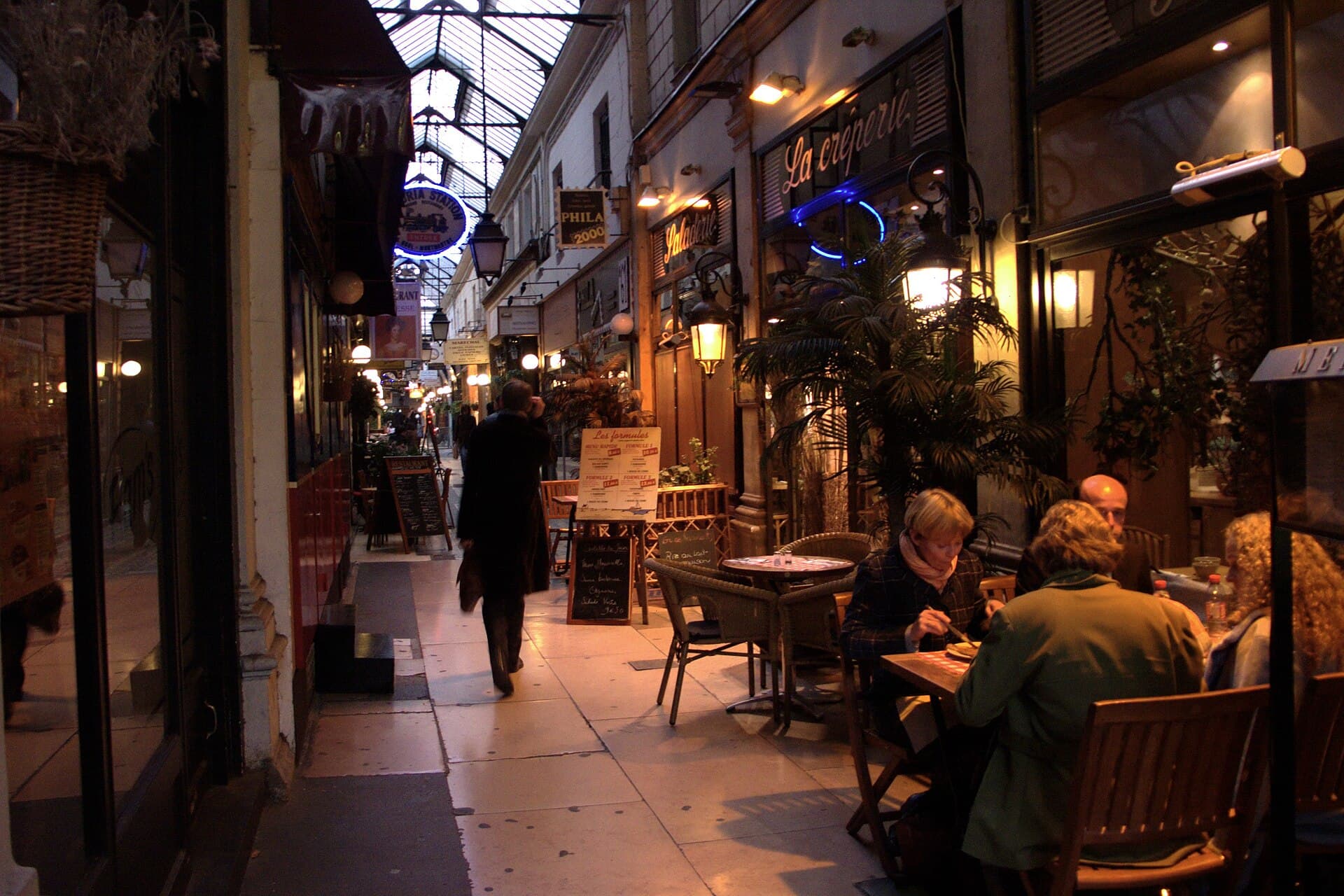
Five stops, about five hours, and not one of them is on a postcard. Secret Paris starts under the glass roof of the Passage des Panoramas, open since 1799 and the first street in the city lit by gas in 1817; crosses into the Palais-Royal garden, where a stammering 29-year-old lawyer named Camille Desmoulins climbed onto a café table on 12 July 1789 and two days later the Bastille fell; sits in Sainte-Chapelle in the mid-afternoon, when 1,113 panels of thirteenth-century glass catch the sun inside a building that cost a third of what the relic it was made to hold did; goes 131 steps down to six million Parisians stacked in an old limestone quarry; and ends after dark at an unmarked red door on Rue Charlot. Paris keeps its best things behind plain doors. This walk tells you which doors, and what to order once you are through them.
This tour is free thanks to our sponsors.
Subscribe to remove adsStops on this tour
- 1
Passage des Panoramas
Two ways in: 11 Boulevard Montmartre or 10 Rue Saint-Marc. Once you are under the glass, look at the shopfronts rather than into the shops - a lot of the painted signage and carved wooden framing is nineteenth-century, which is why the passage was listed as a monument historique in 1974. The address to find is number 47: Stern, engraver, in business here from 1834 until 2014, cutting calling cards, letterheads and invitations for duchesses and courtesans alike. Its neo-Renaissance carved interior was classified in 1983 and is still there, intact, inside Caffè Stern, run now by the Alajmo family of Venice; order a coffee at the bar if all you want is to stand in the room. The passage itself opened in 1799 on the former gardens of the Hôtel de Montmorency-Luxembourg, which makes it the oldest covered passage still standing in Paris. The name comes from the two rotundas that stood at the boulevard end holding Robert Fulton's imported panoramas, 360-degree painted canvases; they were demolished in 1831. In 1817 this became the first street in Paris lit by gas. Émile Zola walked Nana through these galleries in 1880, and the stage door of the Théâtre des Variétés, where Offenbach premiered La Belle Hélène in 1864, opens straight into the passage. The side galleries - Feydeau, Saint-Marc, Montmartre - are stamp dealers. Lunch: Racines at number 8, burrata then the fresh tagliolini, and ask for a glass of something from the Jura.
- 2
Palais-Royal gardens
You are standing in a formal garden of about two hectares, clipped lime trees in rows, a fountain, and arcades closing it on three sides: Galerie de Montpensier along the west, Galerie de Valois along the east, Galerie de Beaujolais across the north. Those arcades are the whole story. Louis Philippe II, Duc d'Orléans, was ruinously in debt, so in 1780 he had the architect Victor Louis build them and let them to shops, cafés, gambling rooms and brothels - and because the ground was private ducal property, he barred the royal police from setting foot on it. Pre-revolutionary Paris suddenly had a legal vacuum in the middle of itself, and every banned pamphlet in the city was sold here. Walk the Montpensier side and find where the Café de Foy stood: on 12 July 1789 Camille Desmoulins, a 29-year-old lawyer who stammered badly, climbed a table there with a pistol in each hand, shouted Aux armes, and pinned a green chestnut leaf to his hat as a cockade. The Bastille fell on the 14th. He was guillotined on 5 April 1794 alongside Danton; his wife Lucile eight days after him. Under the Beaujolais arcade a plaque marks the apartment where Colette lived from 1938 until her death in 1954, with Jean Cocteau two floors below. In the Cour d'Honneur to the south are Daniel Buren's 260 striped columns, Les Deux Plateaux, installed in 1986 and fought over in court and in the papers for a decade. Coffee: Café Nemours on Place Colette, terrace facing the Comédie-Française stage door.
- 3
Sainte-Chapelle
The entrance is on Boulevard du Palais, inside the Palais de la Cité - the queue you join is the security screening for an active courthouse, not for the chapel. You come in at the lower chapel, built for the palace household: a low vault painted deep blue and scattered with gold fleurs-de-lys, with the towers of Castile repeated on the columns for Blanche of Castile, Louis IX's mother. Stay down there long enough for your eyes to adjust, because the narrow spiral stair delivers you straight into the upper chapel and the contrast is the design. Fifteen windows, each around 15 metres tall, carrying 1,113 stained-glass scenes that read bottom to top and left to right, Genesis in the north round to the Apocalypse in the west rose; about two-thirds of the glass is the original thirteenth-century work, the oldest and most complete Gothic ensemble anywhere. Built 1242 to 1248 and consecrated on 26 April 1248 - under seven years, which for a Gothic building of this quality is extraordinary. It exists to hold one thing: the Crown of Thorns, plus a fragment of the True Cross and around twenty other Passion relics bought from the bankrupt Baldwin II of Constantinople for 135,000 livres, against 40,000 for the entire chapel. Go between 2 and 4 in the afternoon on a clear day; morning light is flat and after five it is dead. The spire is Viollet-le-Duc's, 1840s - the Revolution used the building as a grain store and an archive and took the original one down.
- 4
Les Catacombes de Paris
The entrance is the small building at 1 Avenue du Colonel Henri Rol-Tanguy on Place Denfert-Rochereau, beside Bartholdi's Lion of Belfort. Book online in advance - same-day tickets routinely sell out - and then it is 131 steps down a spiral stair, 19 metres below the street, into a steady 14 degrees. Take a jacket even in August. You then walk about fifteen minutes through empty limestone gallery with nothing in it at all, which is part of the effect. The doorway, when it comes, is a lintel painted in black and white stripes carrying eight words: Arrête! C'est ici l'empire de la mort. Behind it, femurs stacked like cordwood and faced with courses of skulls set in crosses and hearts, and the remains of roughly six million people. The reason is the Cimetière des Saints-Innocents by Les Halles, in use for nearly a thousand years, where the ground had risen above the surrounding streets and where, in May 1780, a retaining wall gave way into a cellar on Rue de la Lingerie. Louis XVI ordered the cemetery emptied; from 1785 the bones crossed Paris at night in black-draped carts behind chanting priests, and the ossuary was consecrated on 7 April 1786. Your route is 1.7 km of a network estimated at around 300 km, and everything off it is illegal to enter. Watch for the marker to Philibert Aspairt, lost down here in 1793, found in 1804, identified by his keyring, and buried where he fell.
- 5
Little Red Door
60 Rue Charlot, Haut-Marais, third arrondissement. No sign, no posted menu, no bouncer, no window: a small dark red door in a plain frontage, and you will walk past it once before you believe it. Ring, push, and inside there are around forty seats, exposed stone, velvet and low red light. Open since 2012, in the World's 50 Best Bars every year from 2015, and sixth in the world in 2022, the highest a Paris bar has stood. Doors from about 6pm; the room is at its best around 8:30 and gets crowded after 10. The list is rebuilt every year around a single idea rather than a set of classics - past editions have been built on farmers, on herbalists, and on a carbon-footprint brief that restricted the bar to ingredients grown near Paris - so the useful move is to describe what you like and let the bartender choose. Two fallbacks within five minutes if it is full: Candelaria at 52 Rue de Saintonge, where the bar is through the back door of a taqueria, and Sherry Butt at 20 Rue Beautreillis. Three minutes north is the Square du Temple, an ordinary park with a playground and no ceremony about it, which is where the Temple Tower stood - Louis XVI and Marie Antoinette were held in it from 1792, and Napoleon had it pulled down in 1808 to stop royalists coming to pray. Food: L'As du Fallafel, 34 Rue des Rosiers, the falafel spécial from the takeaway window, closed Friday evenings and Saturdays.
Reviews
No reviews yet
Be the first to share your experience