About this tour
A first walk through the middle of Porto with Zé, who spent twenty years behind a bar counter down in the Baixa and will tell you what is actually true. Twelve stops, from the tiled hall of São Bento to a francesinha on Santa Catarina — by way of the cathedral, the bridge Eiffel did not build, a church of gold standing over a room of bones, and the bookshop whose famous story the author herself denied. Food and drink the whole way: port, a fino, and the exact words to say at a Portuguese counter so you never have to point at anything. About 4.5 km and four hours at a walking pace, longer if you go inside things. Fair warning — the middle of this route drops sixty metres down stone stairs and climbs seventy-five back up, and the funicular is closed. It will probably rain. Nobody here is going to apologise for that.
This tour is free thanks to our sponsors.
Subscribe to remove adsStops on this tour
- 1
Estação de São Bento
You are standing inside a working railway station, which is the first thing everybody forgets. The hall carries more than twenty thousand hand-painted tiles, all of them by one man: Jorge Colaço, who began in 1905 and was still at it in 1916. They were fired at the Real Fábrica de Louça de Sacavém and cover roughly 550 square metres. Read them rather than photograph them. The four large panels are the Battle of Arcos de Valdevez in 1140; Egas Moniz presenting his own sons at the court in Toledo after his king broke the oath Egas had sworn on his behalf; the arrival of João I and Philippa of Lancaster in Porto in 1387; and the fleet leaving for Ceuta in 1415. Be precise about that wedding, because the city gets it wrong in its own favour: the Anglo-Portuguese alliance was signed the year before, at Windsor, on 9 May 1386. The marriage sealed it. Above the panels runs a smaller frieze on the history of transport, ending in the railway that swallowed this site. The building is by José Marques da Silva and opened on 5 October 1916. Under it stood the Convento de São Bento de Ave-Maria, a Benedictine convent of women; the last nun died in 1892 and the church came down in 1900. At any counter here, ask for um cimbalino. That is an espresso, and only in Porto.
- 2
Sé do Porto & Terreiro da Sé
Turn your back on the church first and look at the city. Then look at the building, and notice that it was never only a church: towers like a keep, walls like a bank, a rose window almost apologising in the middle. The Romanesque fabric went up through the twelfth and thirteenth centuries, when a cathedral on a hill above a river was also a fortress and the bishop was a landlord with soldiers. The Baroque loggia stuck onto its north flank is by Nicolau Nasoni, added in 1736 — the first of three Nasoni buildings on this walk. He was born in Tuscany in 1691, arrived in Porto in 1725 at the Dean's invitation, and died here in 1773 aged eighty-two. Inside, the Gothic cloister was built under João I and lined in 1729–1731 with azulejos by Valentim de Almeida illustrating the Song of Songs. The square is the youngest thing here. It was made by demolition: the medieval blocks around the cathedral were cleared in the 1940s, finishing in 1940, and the twisted pillory that looks medieval was inaugurated on 7 June 1945, copied from a 1797 engraving of a lost original. Put your hand on the wall. Two-mica granite, roughly 310 million years old, and named an international heritage stone in September 2024 — by the geologists' own body, the IUGS, whatever the local papers said about UNESCO.
- 3
Ponte Luís I — upper deck
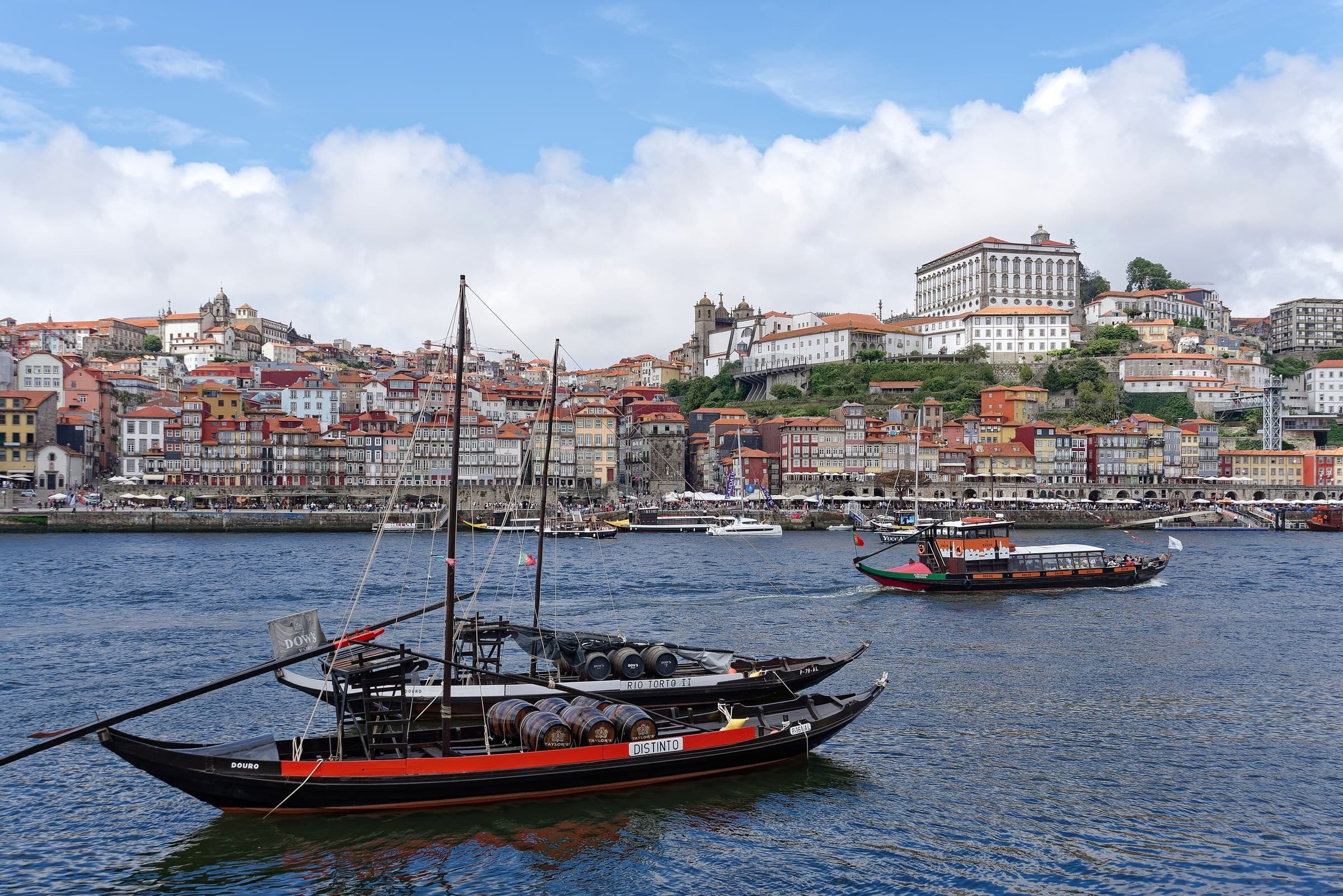
This is not Eiffel's bridge, and correcting that is the single most useful thing you can do in Porto. It was designed by Théophile Seyrig, born in Berlin on 19 February 1843 and French by career, who had co-founded Gustave Eiffel et Cie with Eiffel in 1868 and split from him in 1879. When the competition for this crossing was judged in January 1881, Seyrig's design beat an entry from Eiffel's own firm. Built 1881 to 1886: a main arch of 172 metres, a deck 385 metres long, and this upper level 45 metres above the water, shared with Metro Line D — a train will pass a few metres from your shoulder. Eiffel's real Porto bridge is the Maria Pia upstream, inaugurated on 4 November 1877, the longest single-arch span in the world when it opened, and carrying nothing at all since 1991. Look across to Vila Nova de Gaia, which is a different municipality with its own mayor and will correct you about it. Port wine is not made in Porto: the grapes grow 85 to 90 kilometres upriver on schist terraces in the Douro, and the wine aged over there because that bank is cooler and damper. The rabelo boats below are for photographs; commercial traffic ended in the 1960s. Order a tawny slightly cold, or a porto tónico.
- 4
Praça da Ribeira
Getting down here is the hardest part of the day. The Funicular dos Guindais has been shut since 18 July 2026 for a safety certification review with no reopening date, so the only way on foot is the Guindais stairs: sixty vertical metres of uneven granite, no handrail for most of the descent, genuinely slippery after rain, and not passable with a wheelchair or a pushchair. The step-free alternative is a taxi down Rua Mouzinho da Silveira. The little closed station at the bottom has the better story. The first funicular opened on 4 June 1891 and ran for exactly two years and one day. On 5 June 1893 an operator failed to slow a car, it struck its support and came off the rail — and here is the correction the city still has not absorbed: nobody was killed. Three people were aboard, a conductor, a passenger and his six-year-old daughter, and they walked away with minor injuries. The panic rumour of deaths outlived everyone who started it. They closed the line anyway, left the cliff alone for 111 years, rebuilt it in 2004, and shut it again this July. Now look around. The stacked houses with the washing out are the postcard, and they earn it. The terraces on the water, with laminated menus in six languages and a man outside, are the worst value in Porto. Eat two streets back.
- 5
Casa do Infante
A plain stone building with a courtyard that refuses to announce itself, and it is the oldest surviving building in the city — dated to 1325. Tradition holds that Henry the Navigator was born in a room in there in 1394. Hold that as tradition, not fact: no birth record survives, and the historian José Hermano Saraiva made a serious case for the monastery at Leça do Balio, a few kilometres north. What is certain is what the building did. It was the royal customs house and mint, which means that for centuries everything that entered Porto by water was counted, taxed and argued over inside these walls. Cod. Cloth. Sugar. Gold. And people: human beings entered in the ledgers as cargo, in a room you can walk into this afternoon. Henry's inheritance is genuinely double — the Atlantic voyages that made the country rich are the same voyages that opened the Atlantic slave trade — and you will notice which half of that gets the statue. Look at the silhouette too, because it is less medieval than it looks: two large towers were cut down in a 1677 remodelling that also added two floors to the front. Inside, the municipal museum displays Roman remains found beneath the floor, from the settlement of Portus Cale, which is where the word Portugal comes from.
- 6
Igreja de São Francisco
From the street it is a plain Gothic box, built between 1383 and 1410 by decree of King Fernando I: three naves, five bays, grey and honest. Open the door and every surface inside is carved wood under gold leaf. They call it talha dourada, and it was layered on across the seventeenth and eighteenth centuries until the stone underneath disappeared entirely. Find the thing that looks like a tree growing out of a sleeping man with kings sitting in its branches: that is the Tree of Jesse, Christ's genealogy made literal, carved by Filipe da Silva and António Gomes between 1718 and 1721 in the chapel of Nossa Senhora da Conceição. You will be told the room holds 300, or 400, or 600 kilos of gold. No survey has ever been published, the order that owns the church has never confirmed a figure, and every number in circulation was invented for a brochure. An extraordinary quantity is the honest answer. Then go down. Beneath the floor are the brotherhood's stone burial drawers, and in one corner a grate you can look through into an ossuary holding the bones of the parish poor — under a ceiling worth more than everything they owned. The church has been a National Monument since 1910. The grand building across the square, the Palácio da Bolsa, exists because the fire of the 1832 siege gutted the convent that stood there.
- 7
Rua das Flores & Igreja da Misericórdia
The street was cut between 1521 and 1525, straight through the bishop's vegetable gardens, which is where the flowers in the name come from and why there have not been any for five hundred years. It runs about 380 metres and it was where the money lived: merchants on one side, goldsmiths on the other. There are still goldsmiths here — look in the windows for filigrana, the spun-wire jewellery. The facade of the Igreja da Misericórdia is Nasoni's, the second of his three buildings today. He was called in as a structural troubleshooter in February 1740, not as an architect, and the rebuild he designed ran from 1748 to 1754; the entablature carries the year 1750. The museum next door holds two drawings for that facade, which are the only surviving project drawings from any of his Portuguese works. Two things to actually look at. Above the shopfront at numbers 79 to 83, the Casa dos Sousa e Silva, there is a carved coat of arms with 1703 cut into it. Genuine, unrestored, at eye level plus two metres, and almost never photographed. And Chaminé da Mota, the secondhand bookshop everyone describes as ancient, opened in 1981. In a city this old, feeling old is not evidence. Coffee here: um pingo is an espresso with a drop of milk. In Lisbon the same drink is a garoto.
- 8
Torre dos Clérigos
Stand at the bottom and look straight up before you decide whether to climb it. Nasoni built the church first, between 1732 and 1750, on an elliptical plan that was among the first in Portuguese Baroque, and then the tower from 1754, finishing in July 1763. It is 75.6 metres over six storeys that narrow as they rise, on the highest ground in the city, at a time when almost nothing else here stood above three floors. For two centuries it was what sailors coming up the Douro steered by. The whole complex was paid for by the Irmandade dos Clérigos, formed on 18 April 1707 out of three older confraternities as a mutual-aid fund for priests with no parish and no income — a charity for the unemployed clergy, with the best landmark in Porto. How many steps? Reputable sources say 225 and reputable sources say 240, and the people who run the place publish no number at all; anyone who gives you a definitive figure is guessing. Nasoni died in 1773, aged eighty-two, after forty-eight years here. He had joined the brotherhood, and he asked to be buried in the crypt with them rather than in a tomb of his own. The exact spot was never recorded. The man who gave this city its skyline is somewhere under your feet, unmarked, by his own choice.
- 9
Livraria Lello
Opened on 13 January 1906 and designed by the engineer Francisco Xavier Esteves: neo-Gothic front, stained-glass ceiling carrying the motto Decus in Labore, and that crimson staircase pouring down the middle of the room. For a century nobody could prove the staircase was his. Then the 2017 restoration took it apart and found his signature underneath it, hidden for 111 years. Two more things almost nobody notices: the carved wood above the stairs is painted plaster imitating wood, and there is still a small book cart running on rails set into the floor. Now the queue. J.K. Rowling denied the Harry Potter story herself, publicly, in May 2020: she said she never visited this bookshop, never even knew it existed, that it is beautiful and she wishes she had seen it, and that it has nothing to do with Hogwarts. That is the author, not a rival shop. The true version is better. She did live in Porto from 1991 to 1993, teaching English, in a difficult marriage, with a baby daughter and a manuscript nobody had said yes to yet, and she did write in this city's cafés. A few hundred metres away, the Centro Português de Fotografia was the Cadeia da Relação, the prison where Camilo Castelo Branco, jailed for adultery in 1860, wrote Amor de Perdição in about fifteen days.
- 10
Mercado do Bolhão
Built in 1914 by António Correia da Silva, with Carlos Barbosa engineering a structure that combined reinforced concrete and metal — advanced for a Portuguese market of that date. The same architect went on to design the city hall up the road on Aliados, and if you look at the two buildings you can see he thought they were the same kind of building. The name is not a family or a saint: before anything was built here the plot was marshy ground with a small stream that pooled into a bubbling spring, and bolha means bubble. It closed in 2018 for a renovation that ran four years and started arguments in this city that have not finished. It reopened on 15 September 2022 with more than seventy traders on the ground floor and a run of restaurants above. Cleaner, brighter, and not what it was; both sides of that argument are right. Stalls run Monday to Friday 08:00 to 20:00 and Saturday to 18:00, and it is closed on Sundays and public holidays. Then come out on the Rua Formosa side to number 279, A Pérola do Bolhão, founded on 23 May 1917, with an Art Nouveau tiled front by the Fábrica Cerâmica do Carvalhinho showing spice-route scenes and the words for tea and coffee either side of the name. Still a working grocery. Buy something small.
- 11
Capela das Almas
A chapel covered from pavement to belfry in blue and white tile, and the most photographed wall in Porto. Almost nothing about it is what people assume. The chapel is eighteenth-century. The tiles are not: they went up in 1929, designed by Eduardo Leite, and there are 15,947 of them across roughly 360 square metres. Look at what they actually show, because nobody does — scenes from the life of Saint Francis of Assisi on one side and the martyrdom of Saint Catherine of Alexandria on the other. And then the best fact in the city: they were made in Lisbon, at the Fábrica Viúva Lamego, and brought up here by train. Porto's definitive blue, the one on ten thousand fridge magnets, was manufactured in the rival capital. In the shop windows around you there will be squeaky plastic hammers. On the night of 23 June, at the feast of São João, this entire city goes into the street and hits total strangers on the head with them, and it is the best night of the year. It is also not an ancient tradition. The hammer was invented in 1963 by Manuel António Boaventura, who ran the Estrela do Paraíso plastics factory here, adapting a foreign salt-and-pepper shaker. Students took it up first. It replaced the older habit of bopping people with garlic flowers.
- 12
Café Majestic & the francesinha
Mirrors, carved wood, waiters in waistcoats. The Majestic opened on 17 December 1921 under the name Elite, designed by João Queiroz, and was renamed the following year; it was listed as a building of public interest in 1983 and restored in 1994. What you are buying is the room, and it is worth it once if you go in knowing that. Sit down — standing at the bar here defeats the object. This is also the café most often named as the one where J.K. Rowling wrote in the early nineties, but she has never put her name to this particular room, so take it as the city's claim rather than the author's. Then eat. The francesinha was invented here in the early 1950s by Daniel David da Silva, an emigrant back from France and Belgium, at A Regaleira on Rua do Bonjardim, which opened in 1934 and is still trading. Bread, ham, sausage, steak, more bread, buried in melted cheese and drowned in a hot beer-and-tomato sauce, usually with an egg and chips banked round the edge. The sauce is the whole thing; the meat is scaffolding. Lighter options: Casa Guedes at Praça dos Poveiros 130 for roast pork, and Gazela at Travessa de Cimo de Vila 4, doing cachorrinhos since 1962, cash only, closed Sundays. To drink, um fino. In Lisbon that is an imperial.
Reviews
No reviews yet
Be the first to share your experience